

The Congressional Ground Forces is part of the Ministry of the Ground Forces, which is one of three military sections in the Ministry of Defence. The Congressional Ground Forces is headed by three main persons, the main administrator is a civilian veteran member of the government, the Minister of the Ground Forces (MINGROF), who is appointed by the ruling majority party, then a senior military officer (most commonly an OF-9 or a Ginearálta) who would be the Chief of Staff of the Congressional Ground Forces (CSGF) who is also a member of the joint Chiefs of Staff. The Congressional Ground Forces current projected strength is roughly 315,926 and 138,218 troops reserve personnel.
-Headquarters: MacEoghann Military Base, 2140 Aifric Morace Road, Kilrock, Province of Téachsaís.
-Minister of Defence: Íanrod O'Connel
-Minister of the Ground Forces: Eoin B. Carver
-Chief of Staff: Ginearálta Cioghan Colains
-Vice Chief of Staff: Ginearálta John Tagháin
---------------------------------------------------------------------------------------------------------------
Mission
The Congressional Ground Forces' mission is to defend the Congressional State and project its goals through military means. As of 1959, the Congressional Ground Forces have been issued the commands to bolster democracies in Carinidal, defend Ciarrai's allies and combat all aggressive nations on the continent.The Congressional Ground forces current strategy is centred around the expansion of the nation's armoured forces and the modernisation of all equipment across the board. The Congressional Ground Modernisation Command (GROMODCOM) under General Sean Clancy is overseeing the current modernisation programme nicknamed the "Mústabha Plan" after Field Marshall Michíl Mústabha, the late founder of the armoured forces, the Ground Modernisation Command and a well known proponent of army modernisation.
The Ground Forces' five core competencies are sudden and sustained land combat, combined arms operations (armoured, mechanised, airborne and air assault operations), special operation forces, to set and sustain large invasions and to integrate national, multinational and joint power on land.
---------------------------------------------------------------------------------------------------------------
History
Founding (1897)
The Congressional Ground Forces were formed in 1897 out of the Greenback Militia by General Colm Neely, initially meant to be a national guard and not an offensive force, the Ground Forces consisted of only legitimised militias made into national guard regiments. In 1899, General Neely would begin centralising the Ground Forces into more coherent combat forces with consistent uniforms and structure, first forming the divisions which would then be put in command of many of the former militia regiments, then culminating those regiments into brigades and finally into combat capable corps.
First Deployment (1916)
The Ground Forces would first be effectively mobilised during major unrest in 1916 after the crashing of oil prices across Carinidal. During this time, the Congressional Ground Forces' national guard would take on hundreds of civilian militias across the nation and most notably the revived Provisional Greenback Militia.After the reforming of the Congress post 1918 elections, unrest would subside and the Ground Forces would reclaim hold on order, General Neely would find the divisions needed further commands over them to coordinate as the 1 command of the interior proved overworked and overburdened. General Neely would form the various commands, service component commands, direct reporting units and would reform the structure of the divisions, ensuring that each division would have supporting battalions and not just infantry.
The Great War (1938-1947)
The Congressional Ground Forces would take part in the Great War for its entirety and would rapidly conform to the new age of combat. It's first combat deployment of the war was in Koralberg, where 7 Ciarran divisions as part of the Carinidal Expeditionary Force would fight valiantly and effectively pull its weight during the initial invasion of the FSJN, during the siege of the FSJN capital, Ciarran troops would struggle greatly against the reinforcing UPA and PRU forces and would be forced to retreat slowly with the Koralberg military. Ciarran troops would help hold the line against the advancing triumvirate alliance's onslaught and would effectively prevent the collapse of the frontline when the now extremely experienced Ciarran divisions would lead a devastating breakout attack with armoured forces under the command of the at the time General Michíl Mústabha.Although extremely well armed at this point, the Ciarran expeditionary forces were worn out and could no longer withstand the constant intense fighting on the frontlines, this would cause the Ciarran high command to pull their forces from Kassia and return to Ciarraí in 1943.
The Ground Forces would not see combat again until the Kutsan spring, where the Ciarran forces would rapidly deploy to defend the government of the nation from its rebellions, the Ground Forces would smash through the rebellions defences on the borders and would secure the Edro-Ostein union, Amaraeia and a substantial amount of Kutsan proper in just 6 months, despite their massive gains, the Ground Forces would retreat from Kustan proper when the High Consul would surrender to revolutionary forces. The Ground forces would maintain control over Edro-Ostein and Amaraeia and would easily put down several revolutions in Edro-Ostein.
Several months afterwards, Ciarran forces would be deployed back to Kassia with substantially more armoured forces. Ciarran forces would continue to prop up the Kassian government and would continue to be battle hardened each day under the ferocious fighting.
Ciarran Ground Forces fighting in Kassia.
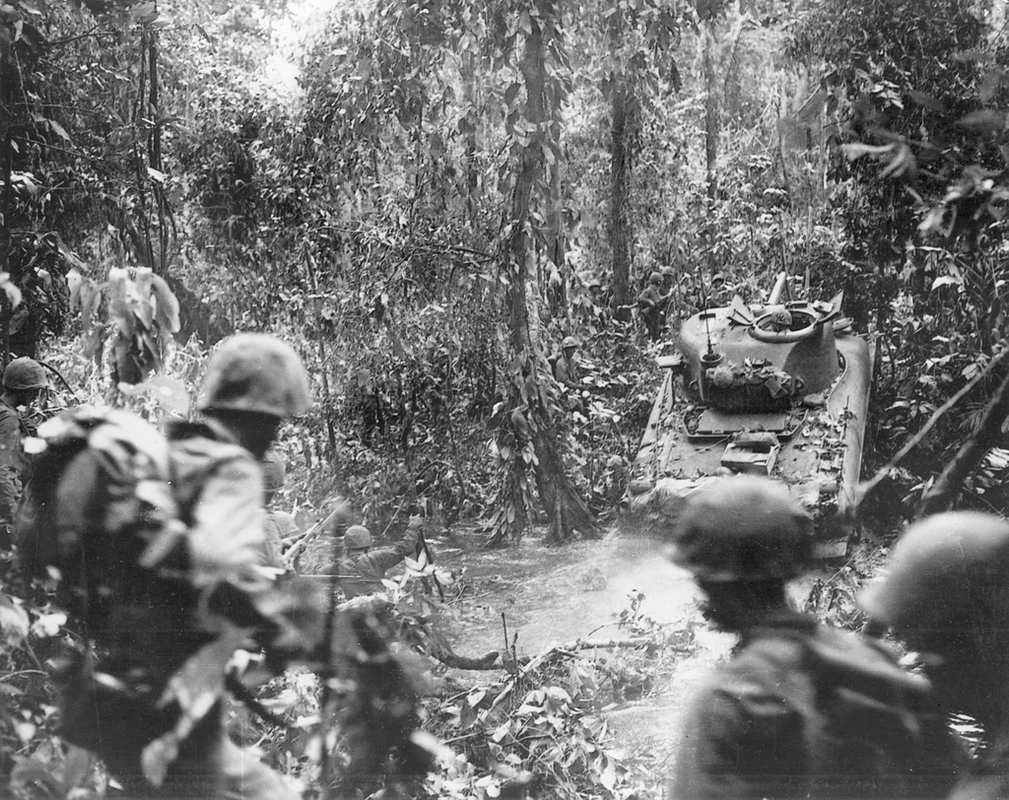
Back home, Nykea and Reveland would also collapse into civil-wars. Ciarraí would invade Reveland and its colonies to prevent the triumvirate alliance from gaining a foothold on the continent, but would allow Nykea to fall as it was weary of stretching its forces too thin.
In 1947 the Congressional Ground Forces would withdraw its forces for the final time from Kassia, the Congressional Maritime Forces would lead a crippling blockade run to extract its over 300,000 troops trapped in Kassia, leading them all the way home safely.
Post War (1947-1954)
Shortly after the end of the great war in 1947, the Ground Forces would be reformed under now Acting Marshal Michíl Mústabha, where he would remove the many temporary divisions formed during the great war and would limit the ground forces to just 24 divisions not including national guard divisions, this was a result of rapid demilitarisation enforced by the Triumvirate. The demilitarisation would last until 1950 when the newly elected Front of Superiority and Military Party would exponentially increase military spending. Despite this, the army would still lack modern vehicles and weapons for a considerable period of time. In 1954, Acting Marshal Michíl Mústabha would die of a heart attack, marking the end of his tenure as one of the greatest military leaders in Ciarran history.Acting Marshal Michíl Mústabha in 1953.
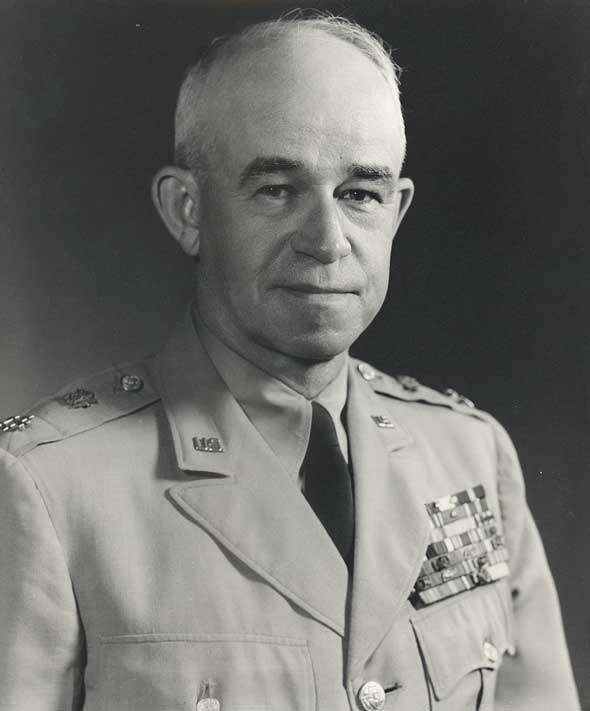
Rapid Modernisation (1954-1958)
After the great nuclear exchange of 1954, Ciarraí would begin it's 3rd Rapid Modernisation Order and begin experimenting more with domestic weapons, finally beginning a total overhaul of all forces. The first new designs made were the modern weapons program, which brought in the RF-8, RF-9, RF-11 rifles respectively. Shortly, new armoured vehicles like the M100 Gael would be introduced alongside the M55 Mustabha, named after the late Michíl Mústabha.Selengrad Civil War (1959-1961)
In early 1959, as the Selengrad Civil War escalated, the Congressional Ground Forces (CGF) were ordered into the region to prevent the collapse of the Selenian government. The initial deployment consisted of approximately 30,000 personnel, primarily drawn from the 2nd Infantry Division, supported by airborne and marine contingents.
At Fort Claymore in the North, the 64th Airborne Division, supported by Ciarran elements, secured Route 71, the critical supply corridor linking Fort Claymore to the interior. The fighting included close-quarters engagements, most notably in Ufazamashinol, where Ciarran paratroopers bravely stormed entrenched anti-tank gun positions under heavy fire.
At Camp Razor in the South, the 2nd Infantry Division, alongside allied formations, conducted major urban and jungle clearing operations. Fighting was characterized by street-to-street combat and widespread use of napalm bombardments to dislodge entrenched militias.
These operations stabilized the frontlines but at considerable cost, marking some of the bloodiest fighting Ciarran soldiers had faced since the Great War. Notably, forces of the Yelenian seperatists engaged camp razor with chemical weapons on the 27th of December, 1959. This day had the most casualties of the entire war and over 392 soldiers would die at Camp Razor alone.
Troops of the 2nd Infantry Division stationed at camp razor, 1959.
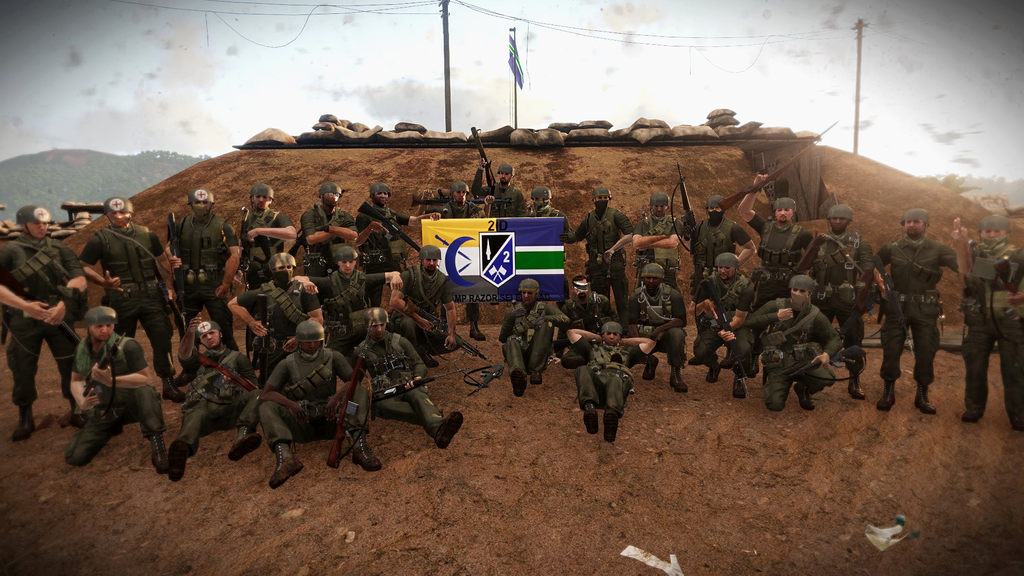
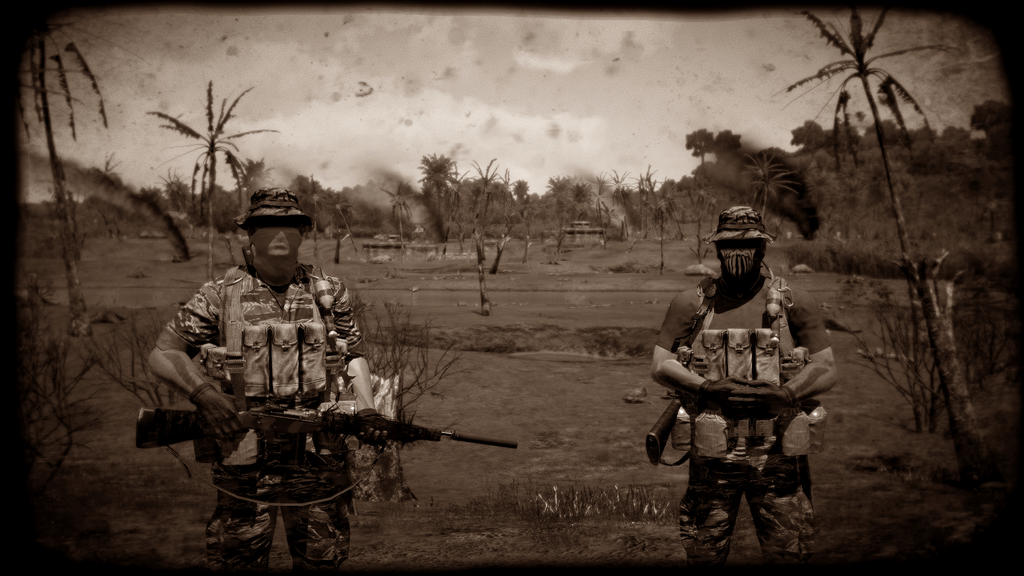
The Ciarran response to the deployment of chemical weapons on camp razor lead to the largest bombing campaign in Ciarran history, operation Rolling Thunder. Operation Rolling Thunder would see over 300 Ciarran aircraft go on a 2 week long campaign of bombing rebel bases, supply routes, radio installations and overall cripple the rebel forces. Operation Rolling Thunder saw the first known deployments of the mysterious 1st Army Ranger Wing special forces group.
Only known picture of troops of the Army Ranger Wing in Selengrad. Seen here at the aftermath of a Ciarran air raid where several chemical weapons storages were wiped out apart of Operation Rolling Thunder.
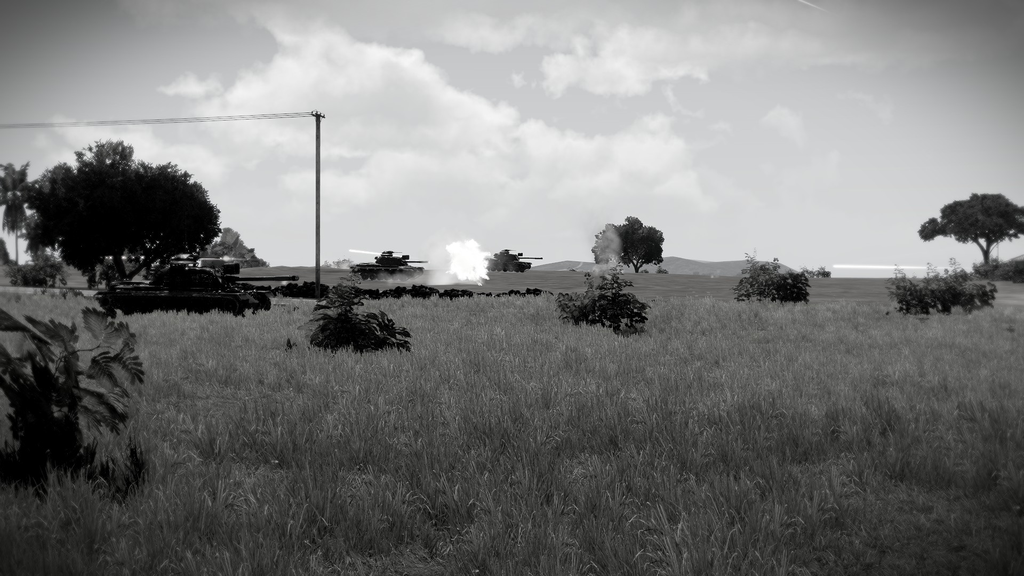
Tanks of the 64th Airborne Division engaging rebel forces on Route 71.
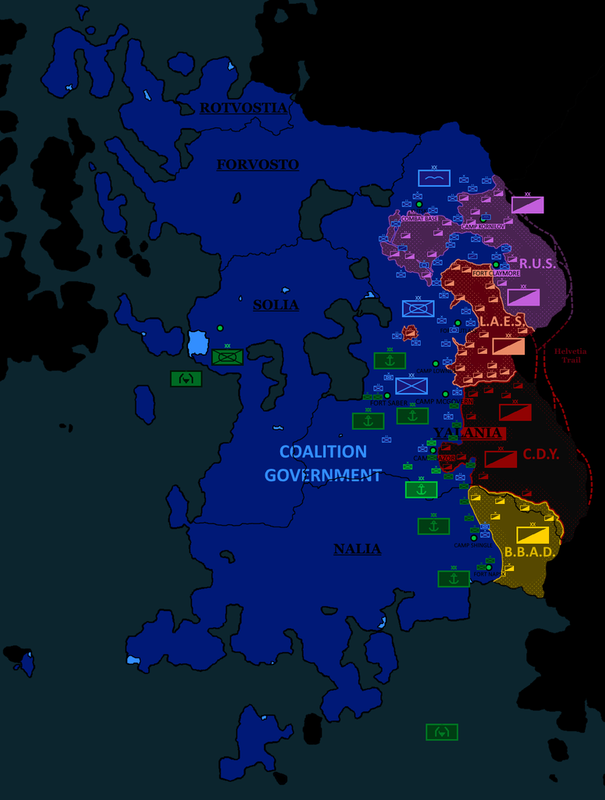
Map of the overall state of the conflict in 1960. Coalition forces depicted in blue and green with rebels depicted in purple, red, black and yellow.
In mid-1961, a snap election in Ciarraí brought to power a government aligned with the expansionist policies of Kutsan. Ciarran forces in Selengrad were ordered to shift their mission from peacekeeping to consolidation of territorial control. At this stage, most of the Selenian Armed Forces had already been retired under Ciarran supervision, leaving the CGF as the dominant organized military structure in the country.
Resistance to Ciarran policy emerged from Toripuru, whose forces had been fighting alongside Ciarran troops throughout the war. Refusing to permit annexation, Toripuruan Marines entrenched themselves in the capital, Zinsala. FORSCOM Selengrad, under Lt. Colm O’Grady, encircled the city and established a siege perimeter. O’Grady issued a formal ultimatum demanding Toripuru’s withdrawal, offering free passage by air and land. After an initial defiant rejection, Toripuruan High Command unexpectedly ordered a full withdrawal. On the following morning, Ciarran troops marched into Zinsala without firing a shot. The CGF immediately undertook clearance of mines, traps, and demolitions left behind in the capital.
The peaceful occupation of Zinsala marked the end of major Ciarran operations in Selengrad. For the first time in two years, Congressional Ground Forces began rotating home, culminating in public celebrations in Traília. Official broadcasts highlighted both the hardships of the campaign and the triumphant return of Ciarran soldiers who had fought through one of the most complex wars in the nation’s modern history.
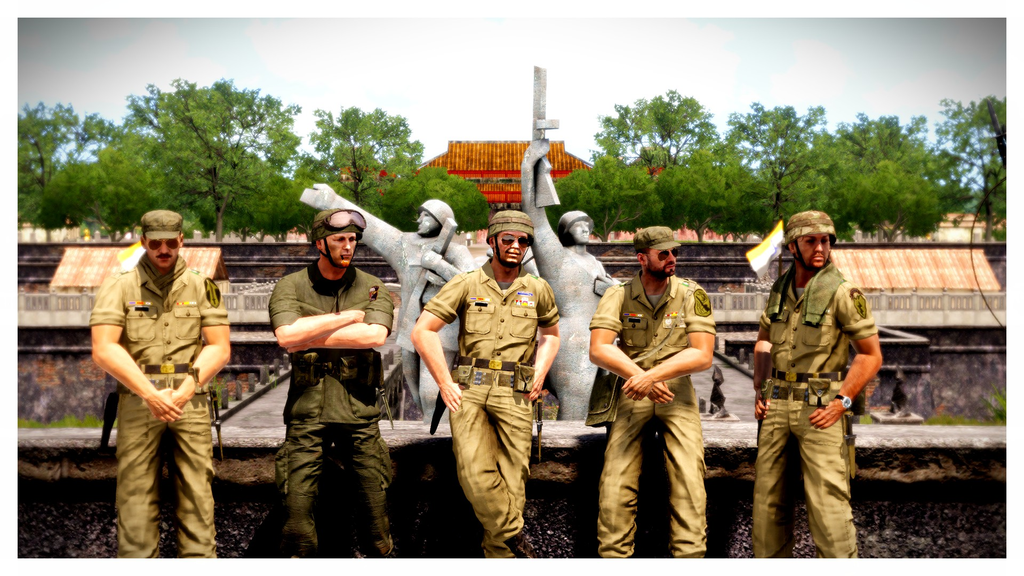
Image of FORSCOM Selengrad Commanders, From left to right: Maor Ghinearál Eoghann Vincenzo, Lefteanant Chornal Jack Gates, Lefteanant Ghinearál Colm O'Grady, Maor Ghinearál Rory Doakes and Maor Ghinearál Hugh MacGregor.
---------------------------------------------------------------------------------------------------------------Organisation
Army Components
The Structure of the Congressional Ground Forces is a complex top down system of commands and headquarter sections administrative to the general ground forces. The ground forces go in order of largest command groups down to the smaller more independent commands like those of divisions and even brigades or battalions.
The Congressional Ground Forces is often given general orders by the Ministry of the Ground Forces. In addition to base closures, unit citations, certain awards like the Clogiad na Laochra (Helmet of the Warriors) and the Order of Cian MacEoghann, they may concern structural changes to the Ground Forces. These are listed by year in public press releases and in the official Congressional Armed Forces newspaper.
The Congressional Ground Forces is made up of just two main components: one active-the Regulars; and one reserve-the Reserves. The Reserves consists of part-time soldiers who train once a month and are ready to be activated should the Ground Forces require them, and the national guard which acts as both a reserve force and an active combat defence force. The National Guard is organised, trained and equipped as a component of the Ground Forces, individual units are under the command of the individual provinces' congresses and governors.
The Congressional Ground Forces is often given general orders by the Ministry of the Ground Forces. In addition to base closures, unit citations, certain awards like the Clogiad na Laochra (Helmet of the Warriors) and the Order of Cian MacEoghann, they may concern structural changes to the Ground Forces. These are listed by year in public press releases and in the official Congressional Armed Forces newspaper.
The Congressional Ground Forces is made up of just two main components: one active-the Regulars; and one reserve-the Reserves. The Reserves consists of part-time soldiers who train once a month and are ready to be activated should the Ground Forces require them, and the national guard which acts as both a reserve force and an active combat defence force. The National Guard is organised, trained and equipped as a component of the Ground Forces, individual units are under the command of the individual provinces' congresses and governors.
-CGF BRANCHES AND FUNCTIONAL AREAS TO BE MADE-
Congressional State Ground Forces Command (FORSCOM)
| Direct Reporting units | current commander | location of headquarters |
| I Corps | LTG Fionn J. O'Donnel | |
| II Armoured Corps | LTG Mathis S. Johansen | |
| IV Corps | LTG Darragh McCarthy | |
| VI Corps | LTG Cillian B. Doyle | |
| X Airborne Corps | LTG Connor A. Kelly | |
| V Missile Defence Corps | LTG Séan Murphy | |
| XI CBRN Corps | BG Eoin J. Byrne | |
| Congressional Ground Space and Missile Defence Command | LTG John J. Blackthorne | Kilbride Camp, Bhirginnia |
| FORSCOM Selengrad (1959-1962) | LTG Colm O'Grady | Camp Razor, Yalania |
| FORSCOM Demeria (1963- | MG Rory Doakes | Camp Carpenter, Kerry |
Active Combat Manoeuvre Units
| Name | headquarters | Subunits | Subordinate to |
| 1st Armoured Division "Big Bess" | MacEoghann Military Base, Téachsaís | 3 ABCT, 1 DIVARTY, 1 CAB, and 1 sustainment brigade | II Corps |
| 2nd Armoured Division "Mako" | Rojer Casement Military Base, Kilciarraig | 3 ABCT, 1 DIVARTY, 1 CAB, and 1 sustainment brigade | II Corps |
| 3rd Armoured Division "Aonach na nGael" | Lannoch Castle, Airan | 3 ABCT, 1 DIVARTY, 1 CAB, and 1 sustainment brigade | I Corps |
| 4th Armoured Division "The Dragonflies" | Fort Dragon, Athenry | 3 ABCT, 1 DIVARTY, 1 CAB, and 1 sustainment brigade | IV Corps |
| 1st Cavalry Division "Black Draughts" | Fort Alarna, Téachsaís | 2 ABCT, 1 DIVARTY, 1 CAB, and 1 sustainment brigade | II Corps |
| 4th Cavalry Division "Red Storm" | Fort Leinster, Leinster | 3 ABCT, 1 DIVARTY, 1 CAB, and 1 sustainment brigade | I Corps |
| 11th Mechanised Division "Rough Riders" | Mór Castle, Athenry | 2 Gael BCT, 1 ABCT, 1 DIVARTY, 1 CAB, and 1 sustainment brigade | IV Corps |
| 15th Mechanised Division "The Big Smoke" | Gallimhe Military Base, Galway | 2 Gael BCT, 1 ABCT, 1 DIVARTY, 1 CAB, and 1 sustainment brigade | VI Corps |
| 1st Infantry Division "The Fianna First" | MacEoghann Military Base, Téachsaís | 2 ABCT, 1 DIVARTY, 1 CAB, and 1 sustainment brigade | II Corps |
| 2nd Infantry Division "Kilcock's Legion" | Justinian Military Base, Wolfetone | 1 ABCT, 1 DIVARTY, 1 CAB, and 1 sustainment brigade | I Corps |
| 3rd Infantry Division "Betio Bastards" | Fort La Neve, Hulcross | 2 ABCT, 1 DIVARTY, 1 CAB, and 1 sustainment brigade | I Corps |
| 4th Infantry Division "The One Trick Ponies" | McKee Barracks, Dùnbàn | 2 Gael BCT, 1 ABCT, 1 DIVARTY, 1 CAB, and 1 sustainment brigade | IV Corps |
| 5th Infantry Division "Hot Iron" | Fort Lynch, Íra | 2 ABCT, 1 DIVARTY, 1 CAB, and 1 sustainment brigade | VI Corps |
| 9th Infantry Division "The Democrats" | Leroux Military Base, Rockail | 2 Gael BCT, 1 ABCT, 1 DIVARTY, 1 CAB, and 1 sustainment brigade | VI Corps |
| 12th Infantry Division "The Cross Keepers" | Fort Lipton, Cavan | 2 Gael BCT, 1 ABCT, 1 DIVARTY, 1 CAB, and 1 sustainment brigade | I Corps |
| 13th Infantry Division "Murphy's Fools" | Doff Military Base, Dúnbán | 2 Gael BCT, 1 ABCT, 1 DIVARTY, 1 CAB, and 1 sustainment brigade | IV Corps |
| 43rd Infantry Division "The Jubilee Jingers" | Joint Branch Base Maolee, Honour | 2 Gael BCT, 1 ABCT, 1 DIVARTY, 1 CAB, and 1 sustainment brigade | VI Corps |
| 102nd Infantry Division "The Tide" | Camp Muckross, Provogh | 2 Gael BCT, 1 ABCT, 1 DIVARTY, 1 CAB, and 1 sustainment brigade | VI Corps |
| 1st Mountain Division "The Highland Stalkers" | Fort Maple, Bhirginnia | 3 Infantry BCT, 1 DIVARTY, 1 CAB, and 1 sustainment brigade | X Airborne Corps |
| 7th Mountain Division "The Scots" | Camp Carpenter, Kerry | 3 Infantry BCT, 1 DIVARTY, 1 CAB, and 1 sustainment brigade | X Airborne Corps |
| 44th Airborne Division "Íra" | Joint Branch Base Kennedy | 1 Airborne Infantry BCT, 1 Infantry BCT, 2 attached Aviation Battalions, and 1 Sustainment Battalion | X Airborne Corps |
| 64th Airborne Division "The Lucky 6-4" | Nel lough Castle, Carinus | 3 Infantry BCT, 1 Airborne DIVARTY, 1 Airborne CAB, and 1 Airborne Sustainment Brigade | X Airborne Corps |
| 70th Airborne Division "Keystone" (Air Assault) | MacEoghann Military Base, Téachsaís | 3 Infantry BCT, 1 DIVARTY, 1 CAB, and 1 Sustainment Brigade | X Airborne Corps |
| 1st Special Forces Division "Fulcra" | MacEoghann Military Base, Téachsaís | 1 Psychological Warfare Brigade, Civil Affairs Brigade, Special Sustainment Brigade | Congressional Ground Special Operations Command |
Combat Manoeuvre Units Under the Interior Command Until Federalised, (National Guard/Home Army)
| name | locations | subunits |
| 41st Infantry Division | Traília, Kerry, Ard Macha, Collins, Muckross, Einland, Padraigh, Cu Cullan, Ráthmor, | 1 Infantry BCT, 1 Gael BCT, 1 CAB, 1 MEB, Sustainment Brigade, |
| 23rd Infantry Division | Traília, Kerry, Ard Macha, Collins, Muckross, Einland, Padraigh, Cu Cullan, Ráthmor, | 1 ABCT, 2 Infantry BCT, 1 CAB, 1 DIVARTY, 1 MEB, Sustainment Brigade, |
| 24th Infantry Division | Kerry, Íra, Ard Macha, Mayo, Kennedy, Jhaigh Jeigh, Carinus, | 1 ABCT, 2 Infantry BCT, 1 Cavalry BCT, 1 CAB, 1 DIVARTY, 1 MEB, Sustainment Brigade, |
| 25th Infantry Division | Íra, Ard Macha, Mayo, Kennedy, Jhaigh Jeigh, Carinus, Fianna, | 1 ABCT, 2 Infantry BCT, 1 Cavalry BCT, 1 CAB, 1 DIVARTY, 1 MEB, Sustainment Brigade, |
| 28th Infantry Division | Íra, Ard Macha, Mayo, Kennedy, Jhaigh Jeigh, Carinus, Fianna, | 1 ABCT, 2 Infantry BCT, 1 DIVARTY, 1 MEB, 1 CAB, Sustainment Brigade, |
| 31 Infantry Division | Fianna, Kennedy, Mayo, Íra, Jaigh Jeigh, Meschir, Honour, | 1 ABCT, 3 Infantry BCT, 1 Cavalry BCT, Sustainment Brigade, |
| 32nd Infantry Division | Dúnbhánn, Galway, Nortumbrigh, Lothundreg, | 1 ABCT, 2 Infantry BCT, 1 Cavalry BCT, 1 CAB, 1 DIVARTY, 1 MEB, Sustainment Brigade, |
| 42nd Infantry Division | Íra, Ard Macha, Mayo, Kennedy, Jhaigh Jeigh, Carinus, Fianna, Múnster, Cavan, Éamonn, Armalite, | 1 ABCT, 2 Infantry BCT, 1 Cavalry BCT, 1 CAB, 1 DIVARTY, 1 MEB, Sustainment Brigade, |
| 43rd Infantry Division | Cathairan, Moch Rith, Siodai, Lough Taisteal, Téachsais, Saibh, | 1 ABCT, 2 Infantry BCT, 1 DIVARTY, 1 MEB, 1 CAB, Sustainment Brigade, |
| 49th Infantry Division | Sailorsville, Foigh, Bogside, Siodai, Moch Rith, Rockail, | 1 ABCT, 2 Infantry BCT, 1 Cavalry BCT, 1 CAB, 1 DIVARTY, 1 MEB, Sustainment Brigade, |
| 50th Infantry Division | Bhirginnia, Wolfetone, Séan, Dún Na Ghal, Ulster, Hulcross, Malford, Rockail, Sailorsville, | 1 ABCT, 2 Infantry BCT, 1 Cavalry BCT, 1 CAB, 1 DIVARTY, 1 MEB, Sustainment Brigade, |
| 57th Infantry Division | Téachsais, Leinster, Saibh, Mac Sweeny, Provogh, Wolfetone, Airan, Armagh, Ulster, Bhirginnia, | 1 ABCT, 2 Infantry BCT, 1 DIVARTY, 1 MEB, 1 CAB, Sustainment Brigade, |
| 101st Infantry Division | Lothundreg, Dúnbhánn, Galway, Fianna, | 1 Infantry BCT, 1 Gael BCT, 1 CAB, 1 MEB, Sustainment Brigade, |
(Structure of individual brigades to be made)
Special Operations Forces
Congressional Ground Special Operations Command (CONSOC)| name | headquarters | structure and purpose |
| 89th Pathfinder Brigade | Fort Warr, Galway | In addition to a Brigade headquarters, a special troops battalion, and a military intelligence battalion, the 89th Pathfinder Brigade has two manoeuvre battalions of elite airborne infantry specializing in large-scale, joint forcible entry operations and precision targeting raids. Additional capabilities include special reconnaissance, air assault, and direct action raids seizing key terrain such as airfields, destroying or securing strategic facilities, and capturing or killing enemies of the Nation. The 89th Pathfinder Brigade also helps develop the equipment, technologies, training, and readiness that bridge the gap between special operations and traditional combat manoeuvre organizations. |
Ground Forces Special Operations Aviation Command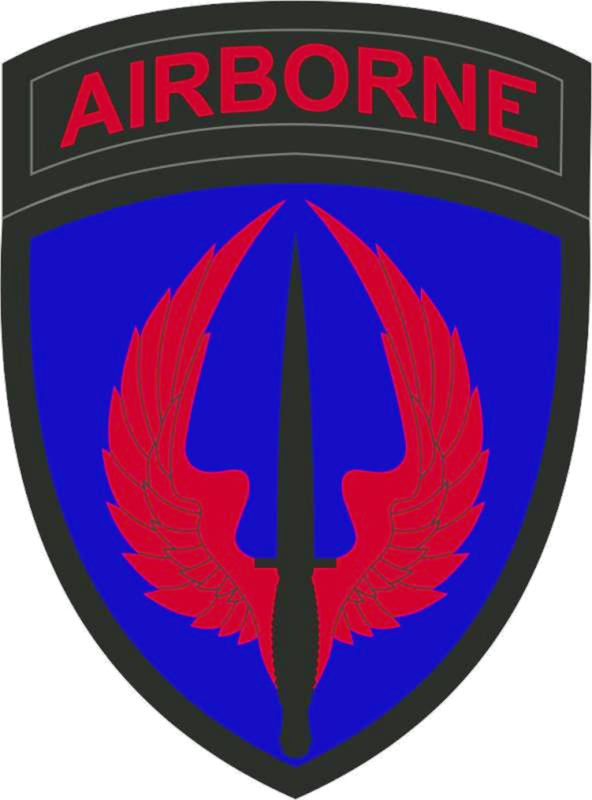 | MacEoghann Military Base, Téachsaís | Commands, organizes, mans, trains, resources, and equips Ground Forces special operations aviation units to provide responsive, special operations aviation support to special operations forces consisting of five units, including the 82nd Special Operations Aviation Brigade "Béan Sídhe" (Airborne) |
1st Special Forces Command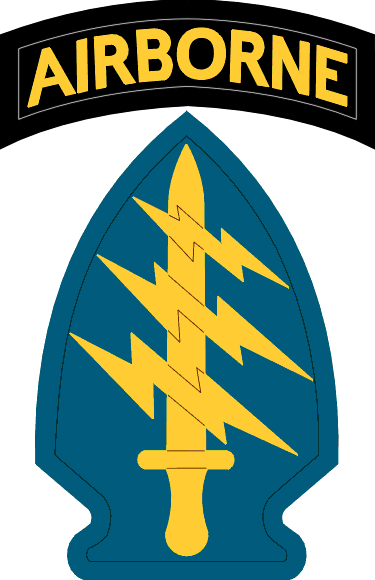 | MacEoghann Military Base, Téachsaís | Manages four special forces groups known colloquially as "Na Fir Ghlasa" or "The Green Men" but officially as the Congressional Ground Special Forces-Special Forces Groups. These are designed to deploy and execute nine doctrinal missions: unconventional warfare, foreign internal defence, direct action, counter-insurgency, special reconnaissance, counter-terrorism, information operations, counterproliferation of weapons of mass destruction, and security force assistance. The command also manages a psychological operations group tasked to work with foreign nations to induce or reinforce behaviour favourable to Ciarran objectives, a civil affairs brigade that enables military commanders and national ambassadors to improve relationships with various stakeholders via five battalions and a sustainment brigade that provides combat service support and combat health support units via three distinct battalions. |
1st Army Ranger Wing 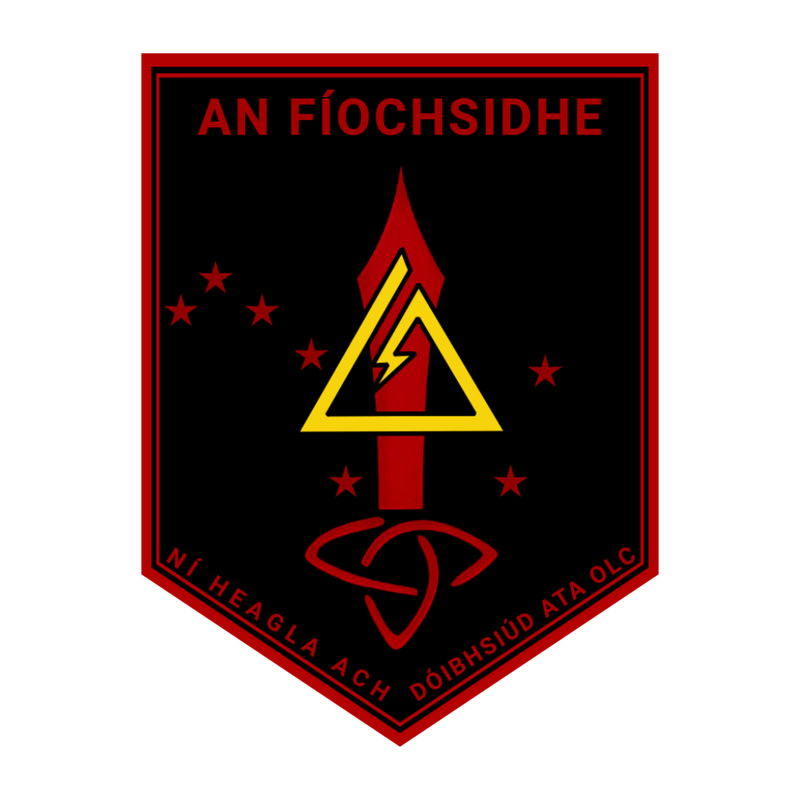 | MacEoghann Military Base, Téachsaís | Commonly referred to as "Na Fianna", "Na Fíochsidhe", "The Warriors" and "The Rangers", ARW-1 is the CGF's Tier 1 Special Mission Unit tasked with performing the most complex, classified, and dangerous missions directed by the National Command Authority. Under the control of Joint Special Operations Command, ARW-1 specializes in hostage rescue, counter-terrorism, direct action, and special reconnaissance against high-value targets via eight squadrons: four assault, one aviation, one clandestine, one combat support and one CBRN. |
| Timothée Modeste Special Warfare Center and School | MacEoghann Military Base, Téachsaís | Selects and trains special forces, civil affairs, and psychological operations soldiers, consisting of two groups and other various training units and offices. |
Medical Service
The Congressional Ground Medical Service (GROMS) is the primary medical organisation of the Congressional Ground Forces and is led by the Surgeon General of the Ground Forces (SGOGF), a 3-star lieutenant general, who also servers as the commanding officer of the Congressional Ground Forces Medical Command. SGOGF is assisted by a Deputy Surgeon General and a full staff, the Office of the Surgeon General (OSTG). The Incumbent Surgeon General is LTG Luke G. Forrester.GROMS encompasses the Ground Forces six non-combat, medical-focused specialty branches or corps, these branches are the Medical Corps, Nurse Corps, Dental Corps, Veterinary Corps and the Medical Specialist Corps. Each of these branches are lead by a Corps Chief that reports to the Surgeon General directly.
Personnel
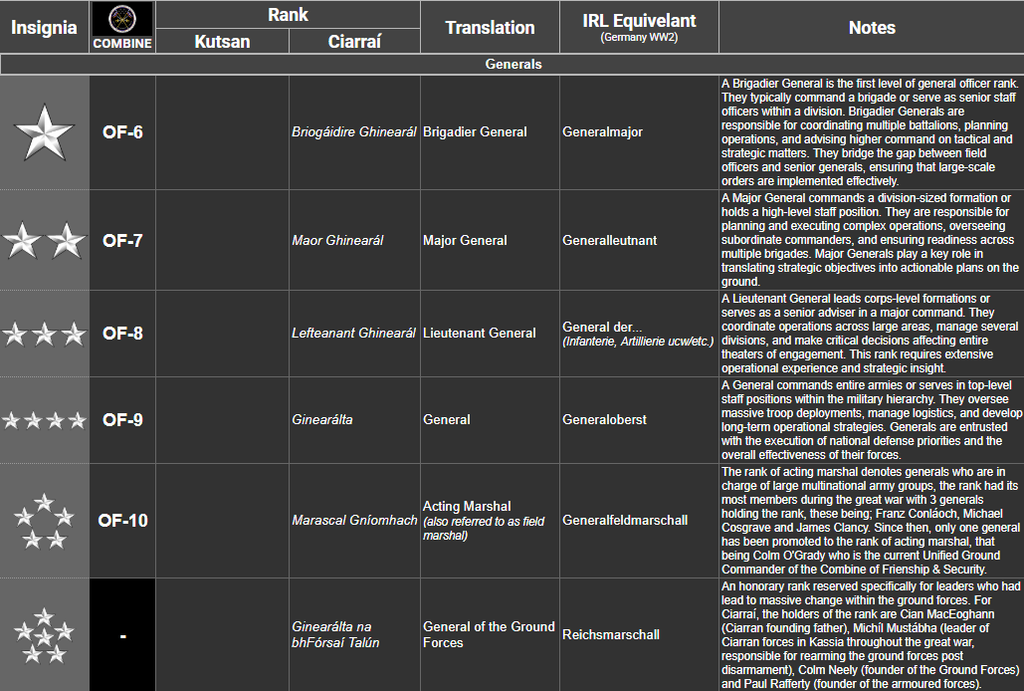
Generals
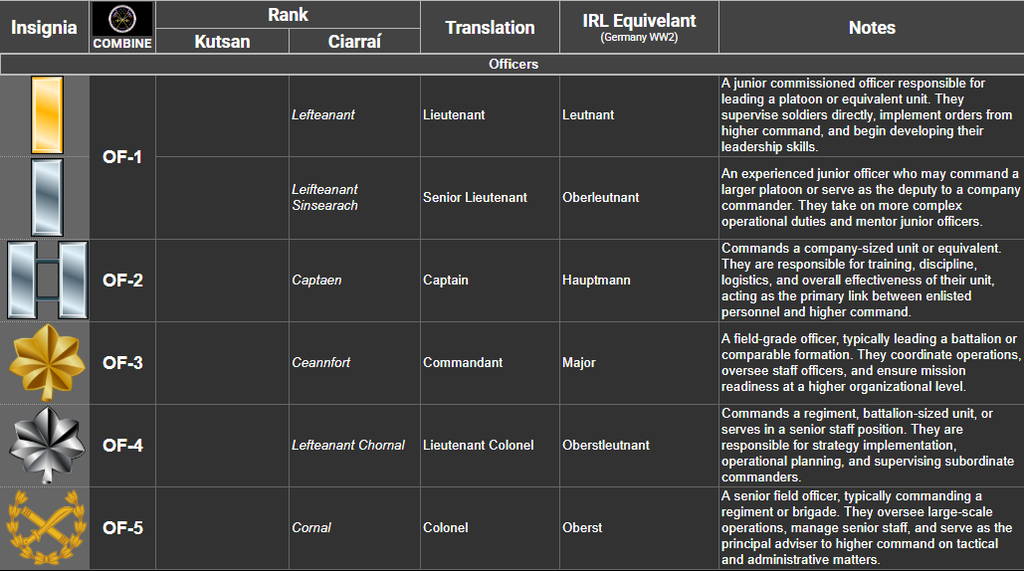
Officers
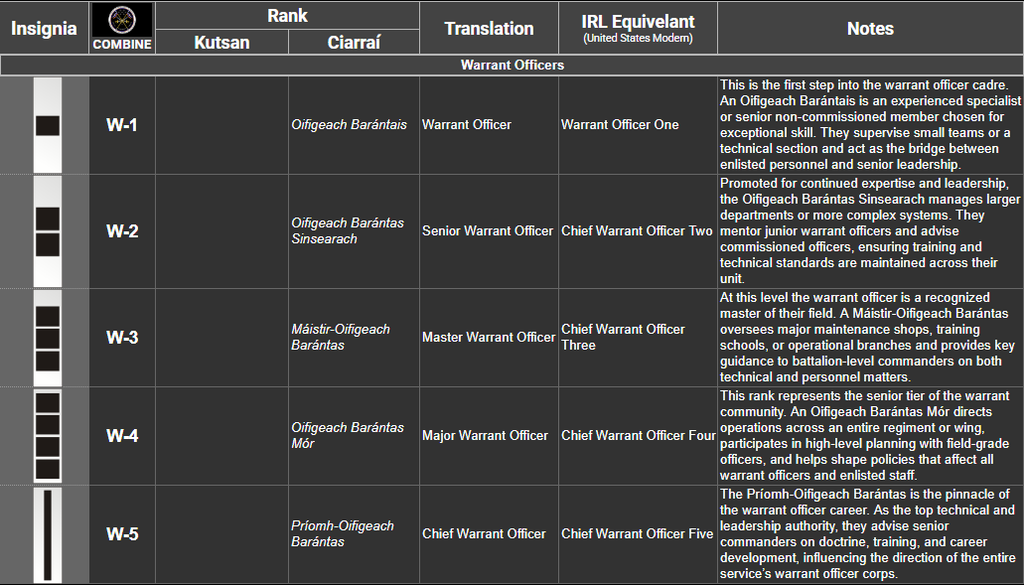
Warrant Officers
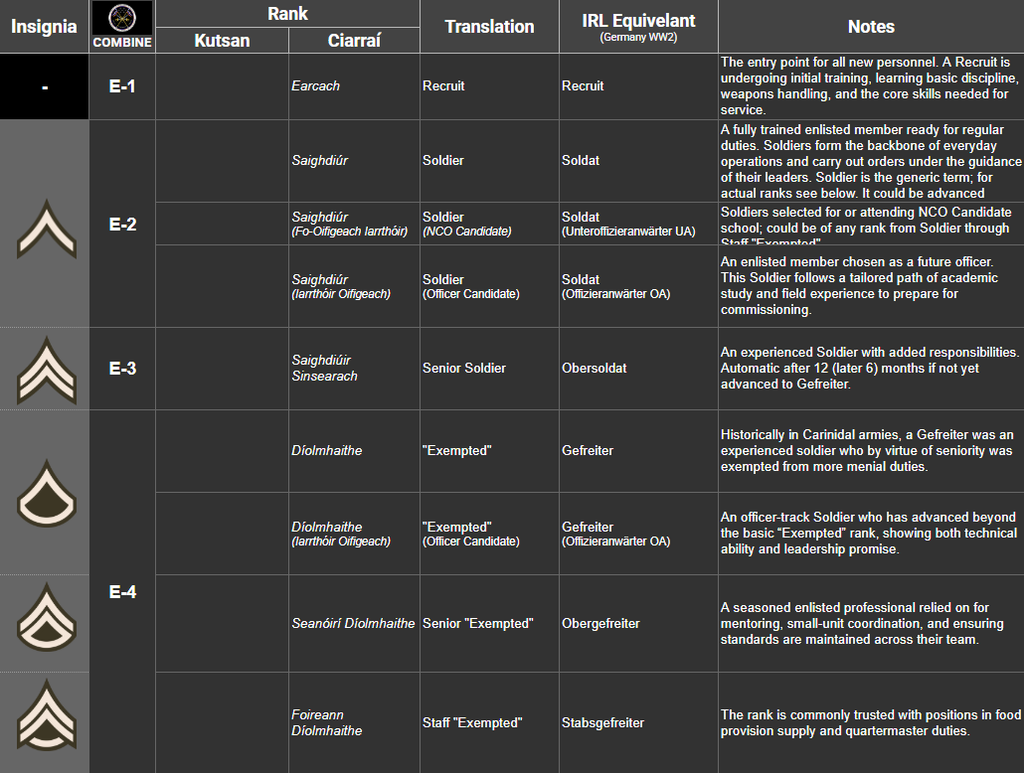
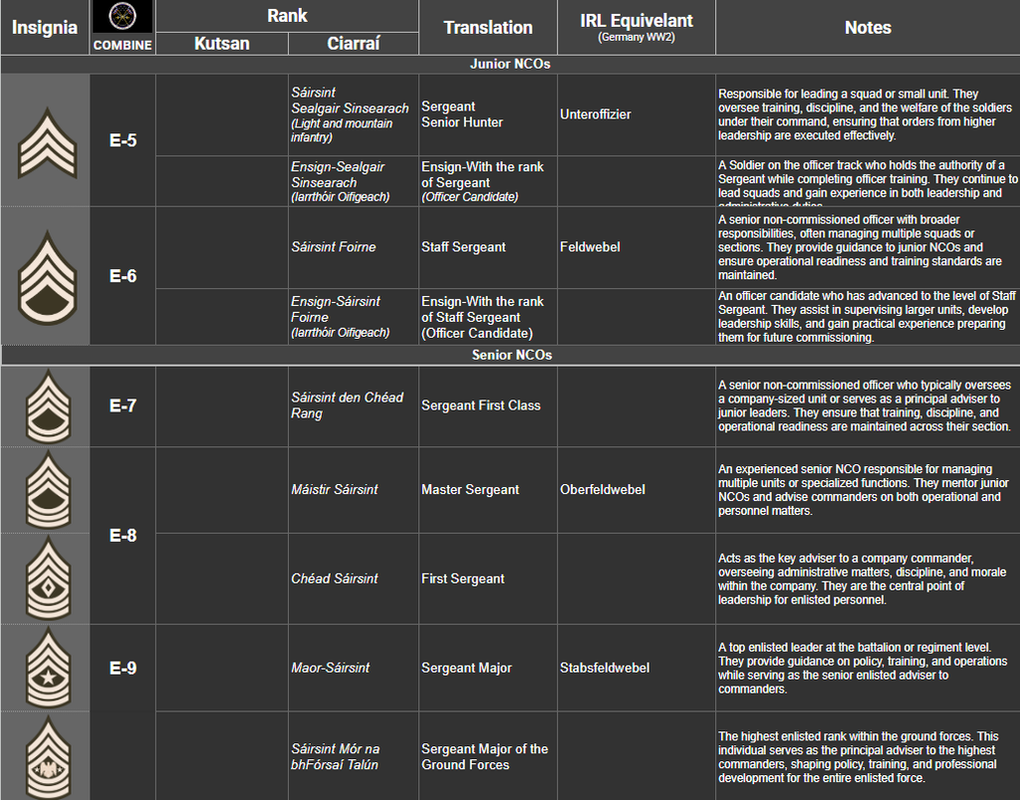
Enlisted
Sergeants and Seanóiri Diolmhaithe are referred to as NCOs, short for non-commissioned officers. This distinguishes Seanóiri Diolmhaithe from the more numerous Diolmhaithe who have the same pay grade but do not exercise leadership responsibilities. Diolmhaithe who have completed the Basic Leadership Course and who have been recommended for promotion will be permitted to wear Seanóiri Diolmhaithe rank before their recommended promotion as NCOs.
Saighdiúrí (E2) and Saighdiúri Sinsearach (E3) are addressed as "Saighdiúr (last name)", Diolmhaithe and Seanóiri Diolmhaithe as "Diolmhaithe (last name)", and sergeants, staff sergeants, sergeants first class and master sergeants all as "Sáirsint (last name)". First sergeants are addressed as "Chead Sáirsint (last name)" and so on.
Equipment
Chief of Staff of the Congressional Ground Forces has identified six modernization priorities, these being (in order): artillery, ground vehicles, aircraft, network, air/missile defence, and soldier lethality.
Weapons
Individual Weapons:
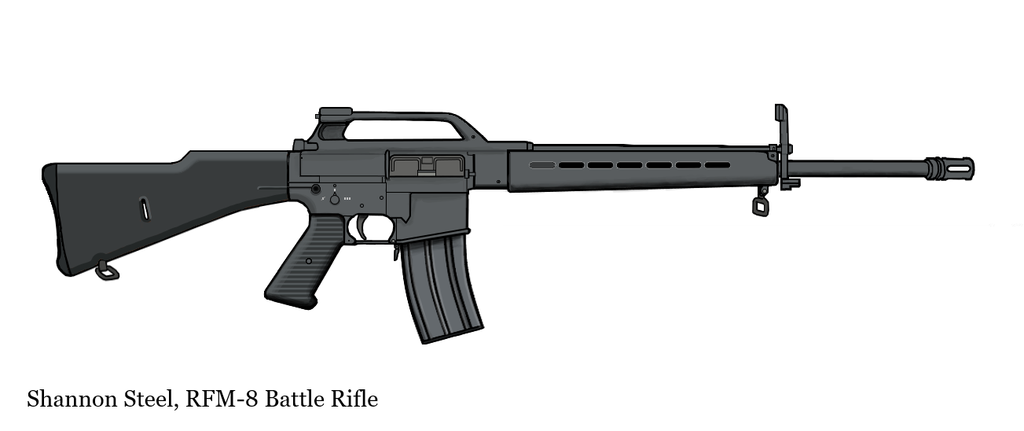
The Congressional Ground Forces employs various weapons to provide light firepower at short ranges. The most common weapon type used as of 1962 is the RF-8, with its carbine variant the RF-11 being rapidly introduced as part of the Ground Forces 4th Rapid Modernisation Order. The primary sidearm of the Congressional Ground Forces is the RF-4 pistol which has been in service since 1912. Soldiers are also equipped with various hand grenades such as the M1928G11 fragmentation grenade and the M1932G15 smoke grenade.
The RFM-9, a modernised variant of the RF-8.
Crew Served Weapons:
The Ground Forces employ various crew served weapons to provide heavy firepower at ranges exceeding that of individual weapons.
The RFM-9, a modernised variant of the RF-8.
Crew Served Weapons:
The Ground Forces employ various crew served weapons to provide heavy firepower at ranges exceeding that of individual weapons.
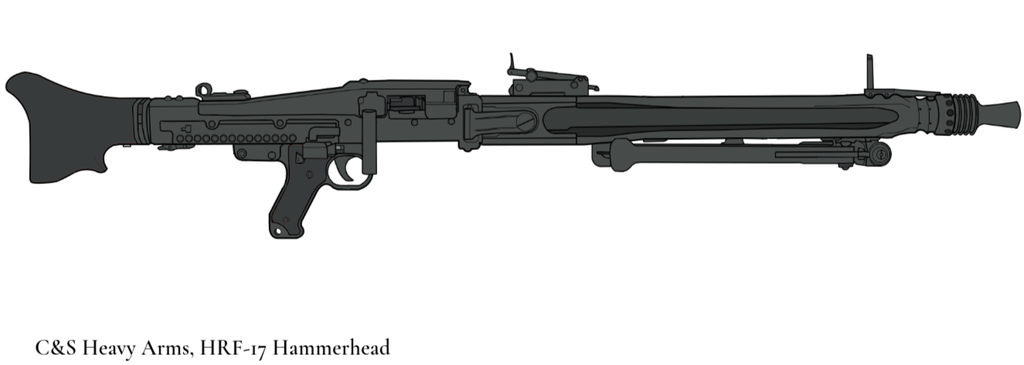
The lightest crew served weapon is the 7.62x51mm COMBINE HRFM-17B "Hammerhead", it is the Ground Forces standard Medium Machine Gun, it's older sibling, the 7.62x51mm COMBINE HRF-14 "Tigershark" is also used but is being phased out. The 12.7x99mm COMBINE HRF-19 "Great White" heavy machine gun and is generally used as the go to vehicle-mounted machine gun but can also be used as a static weapon. In the same way, the 40mm HGL-10 "Monarch" grenade machine gun is also used.
HRFM-17B "Hammerhead", a modernised version of the HRF-17.
The Ground Forces uses three types of mortar for indirect fire support when heavier artillery may not be appropriate or available. The smallest of these is the 60mm M60, normally assigned at the infantry company level. At the next higher echelon, infantry battalions are typically supported by a section of 81mm M81 mortars. The largest mortar in the army's inventory is the 120mm M120/M121, which is usually employed by mechanized units.
The main fire support for light infantry units is provided by towed howitzers, including the 105mm M300 and the 155mm M322.
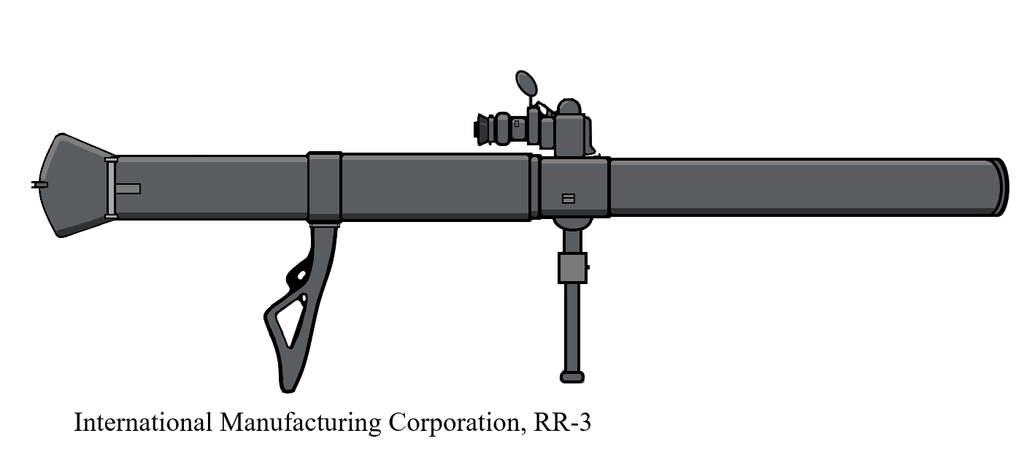
The Ground Forces utilizes a variety of direct-fire rockets and missiles to provide infantry with an Anti-Armor Capability. The HAT-1 is an unguided rocket launcher that fires a projectile that can destroy armour at ranges up to 340 meters, the RR-3 is a heavy recoilless rifle that fires an explosive projectile that can destroy heavier armour and bunkers. The ATM-1 is the ground forces wire guided anti tank missile capable of being deployed on both vehicles and in a static position. Several man portable anti-air and anti tank missiles are also in testing like the MPADS-1 being deployed amongst special forces groups for testing.
RR-3 heavy recoilless rifle.
Vehicles
The Ground Forces place a priority on mechanised and armoured warfare in accordance to the Ground Forces Doctrine. The most common vehicle across the Ground Forces is the M1954A1 light utility vehicle produced by Ciarran Motorworks, it is capable of carrying small groups of personnel, cargo, weapons etc. Heavier utility vehicles consist of the M89 Linebacker HMTV which is the most common material transport vehicle. The most common combat/armoured vehicle is the M100 GAEL APC, which is meant to mainly transport troops to and from combat. It has many variants capable of the same things as the M1954A1 but also has variants able to support heavy weapons, act as a command vehicle etc. Based on the same chassis as the M100 GAEL, the M1A1 CLANCY IFV acts as the main frontline infantry support vehicle, it has very little variants making it solely a combat vehicle. The Main Battle Tank of the Congressional Ground Forces is the M700B2 Conláoch MBT and the vastly less common Heavy Battle Tank of the Ground Forces is the M2A1 Aeorette. Other armoured vehicles consist of the M320 Cathal which is a heavy engineer tank and the M292 mine clearing tractor to name a few.
In 1962, the Ground Forces released the M55C6, an upgrade package to the M55C1 meant to keep the vehicle viable for another 5 years.
The mainline self propelled anti-air vehicle of the Ground Force is the M950 HSPSAM and the mainline self propelled artillery vehicles being the M620 Letterman and M670 Crosbhogha Heavy Self Propelled Howitzers.
M55C6 Mústabha MBT seen testing at an unknown location.
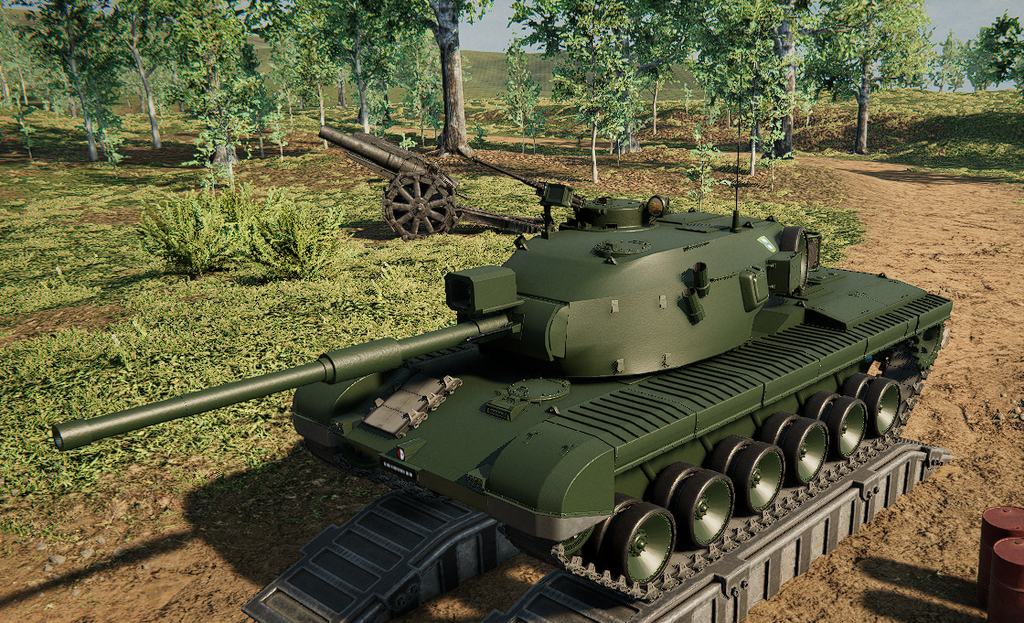
In 1962, the Congressional Ground Forces unveiled a new main battle tank developed in a joint project with Tokaido, the M700A1 Conláoch. The tank builds heavily off of lessons learned from the M55 alongside being a much more effective counter tanks from Toripuru and the FSJN.
M700A1 Conláoch
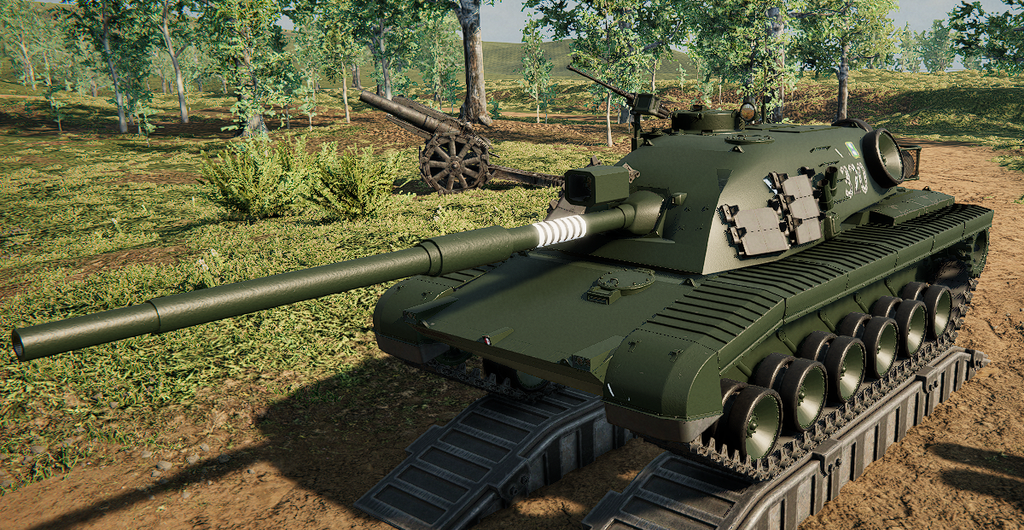
By 1968, the M700 was upgraded several times ultimately resulting in the M700B2, which was meant to replace all previous Mústabha and Conláoch versions and was also intended on being an export variant. It featured spaced armour on the exterior to combat growing HEAT shells across the world, alongside upgraded sights and IR sights.
M700B2 Conláoch
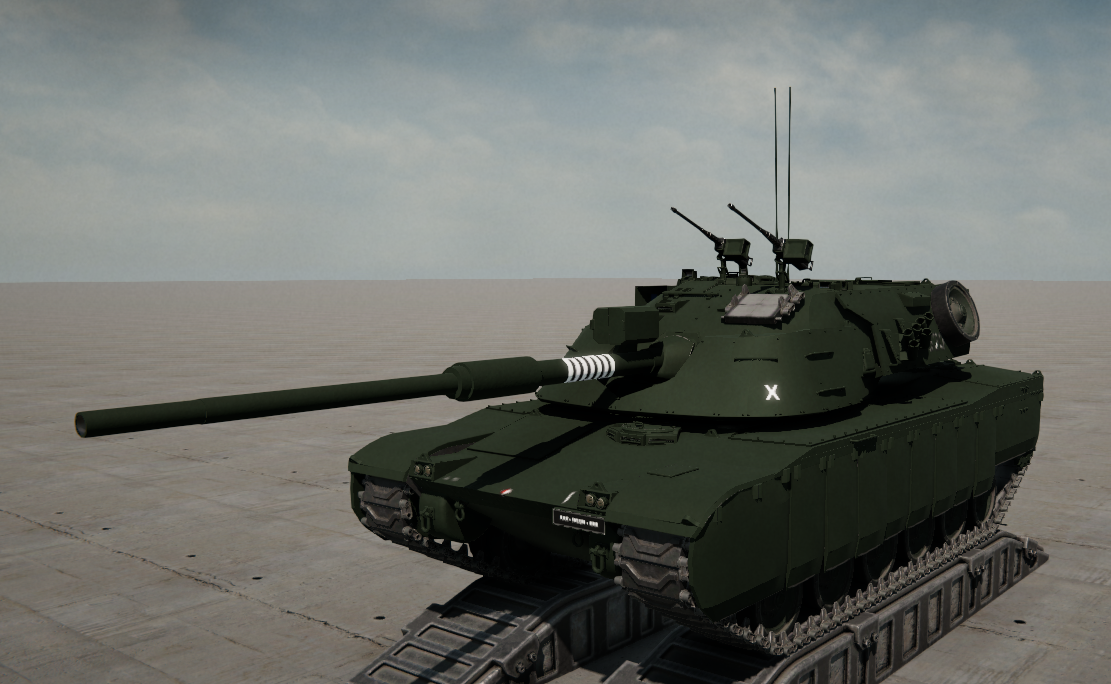
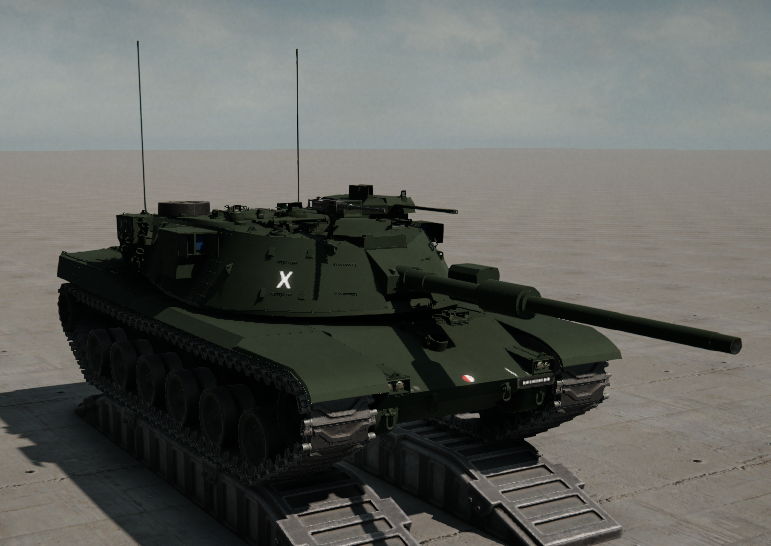
Developed alongside the M700B2, the XMBT70 was developed under the Combine XMBT70 program to deliver the alliance a modern cutting edge armoured vehicle. It features enormous advancements in technology with an autoloader, improved IR sights, radio, a remote controlled 20mm autocannon, smoothbore 105mm cannon and more. It is still being developed but is set to be complete by 1969.
XMBT70125 MBT "ROCKWELL"
Aviation
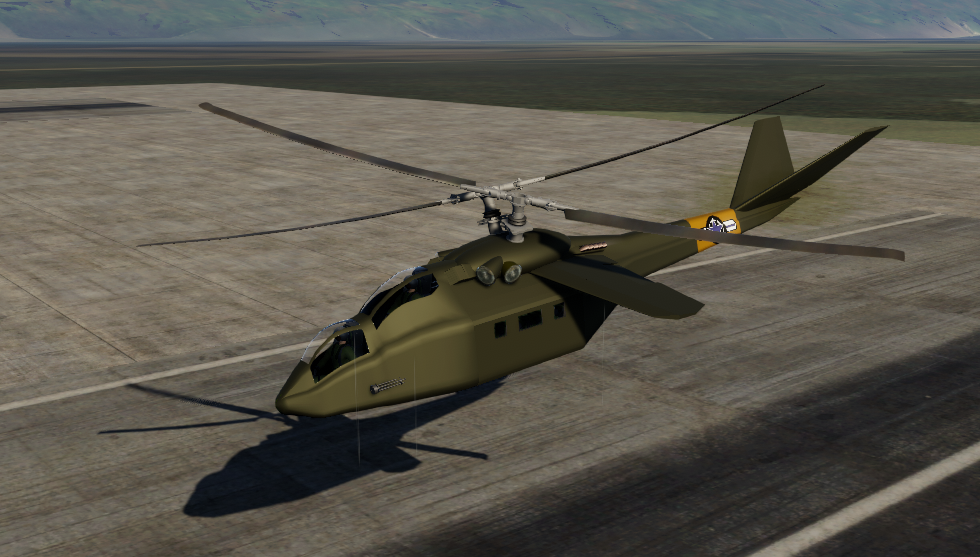
Despite the Ground Air Corps being promoted to an individual branch in the form of the Congressional Air Forces, the Ground Forces still operate a substantial number of aircraft, mainly helicopters. These include the UAH-15A "Kitty" Utility Attack Helicopter, the CH-20A "Troll" heavy lift transport helicopter and the most common UH-10 "Buzzard" transport helicopter.
UAH-15A "Kitty" Utility Attack Helicopter seen in testing at an unknown location.
Uniforms
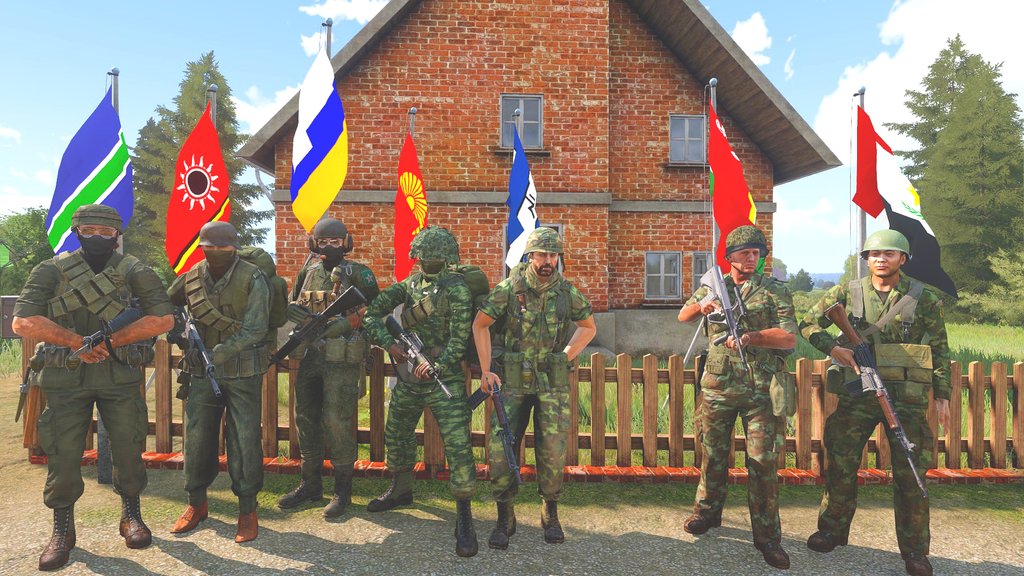
The main Battle Dress Uniform (BDU) of the Ground Forces is the Blarney BDU, it consists of mostly of an olive drab green and comes with the standard webbing in the same colour. Special uniforms like the tan Arid BDU and white Snow BDUs Troops are also issued but are only given in the case that troops are operating in that environment for an extended period of time. Also issued are the M10 Steel Helmet with a covers and standard ruck and bergen packs.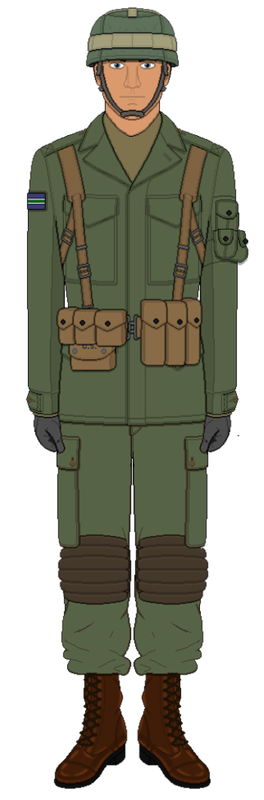
Special forces are known to be experimenting with the Oteran balaclava to better mask their faces, reduce need for face paint and protect face in harsh environments and are also experimenting with the home grown tiger stripe patterns consisting of strips of black, dark green and light green produced by the army ranger wing, other camos being experimented with are the Kutsani lizard camo, the Nortem Alonzo camo, the Reveian and Toripuruan ERDL camo.
Picture of various nations' uniforms. Ciarran uniform seen far left.
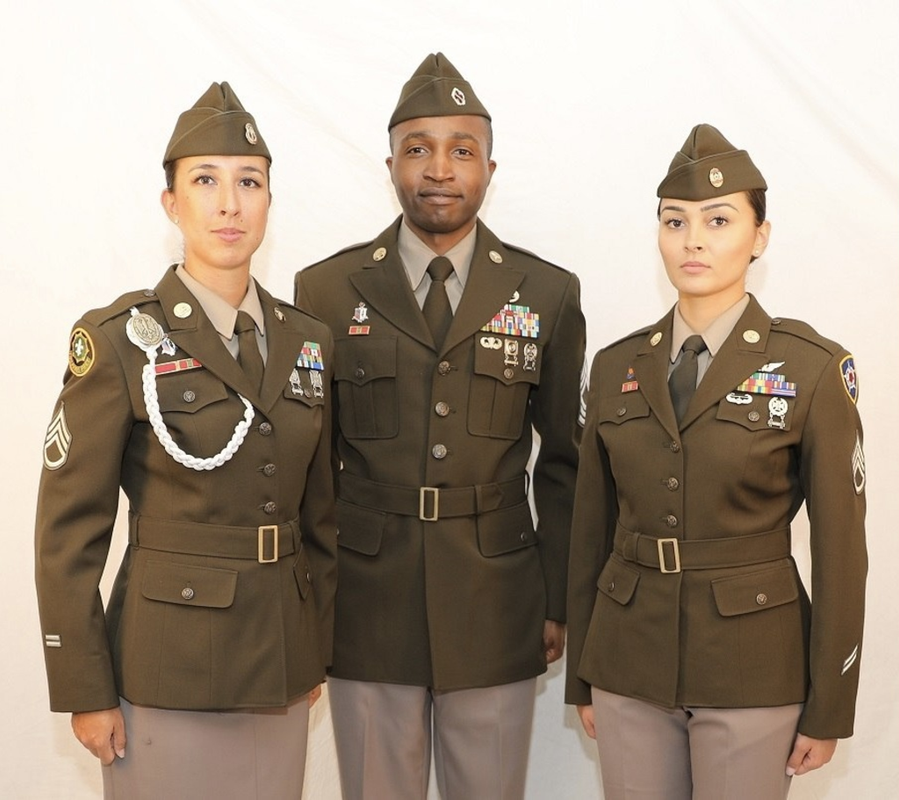
The standard Dress Uniform of the Ground Forces is brown and tan with a standard dress cap. Officers above the rank of Captain are issued the tan utility uniform.
The Standard Dress Uniform.
Berets
The beret flash of enlisted personnel displays their distinctive unit insignia. The general beret of the Ground Forces is the black beret, with special berets issued to specific units for various reasons. The most common non black beret is the green beret of the Military Police units across the Ground Forces meant to display their authority as enforcement, not to be confused with the green berets of the 1st Special Operations Command. Airborne units also dawn a unique beret in the form of the red beret. Members of the 89th Pathfinder Brigade are issued a blue beret.Soldiers who are currently in a unit in jump status still wear berets, whether the wearer is parachute-qualified or not (maroon beret), while members of Security Force Assistance Brigades (SFABs) wear brown berets. Members of the 75th Ranger Regiment and the Airborne and Ranger Training Brigade (tan beret) and Special Forces (rifle green beret) may wear it with the Army Service Uniform for non-ceremonial functions. Unit commanders may still direct the wear of patrol caps in these units in training environments or