META:
The combine was formed by Irish, Gatsby, Blinky and Sanguinius to be the main "bad guy" fascist alliance in Prop Punk. It was initially proposed by Gatsby before inviting other members to a group chat where it was then planned. Every player apart of the Combine is forced to make their nation fascist in some form if they wish to be a member or join as its paramount to keep the ideology of the alliance consistent. The alliance specifically is meant to take over a lot of land and generally cause conflict in the game.
THE COMBINE
The Carinidal-Toka-Artisia-Lycia-Saclun Combine of Friendship is a multinational alliance that emphasises military and economic unity between the nations of Atera. The alliance is structured mainly as a diplomatic alliance first, military second and economic third. The Combine was established initially between Reveia, Ciarraí, Kutsan and Tokaido due to the nation's shared interests and close proximity.
------------------------------------------------------------------------------------
MEMBER STATES
- State of West Reveia
- Congressional State of Ciarraí
- Sublime State of Kutsan
- Empire of Tokaido
- Heiwa Federation
- United Kassian Republic
- Lycia
------------------------------------------------------------------------------------
ARTICLES OF MEMBERSHIP
The articles of membership of The Combine outlines the requirements of each applying nation and expectations of all member states. Each article is considered absolute until repealed or redefined.-ARTICLE 1-
Every member state must exhibit a political orientation coherent with the rest of the alliance,
-ARTICLE 2-
Every member state must show conservative national ideals,-ARTICLE 3-
Every member state must dedicate at least 3% of their gross domestic product to their military,-ARTICLE 4-
Member states' governments must take a vow to upholding their territorial integrity and assisting with the expansion of the alliance,-ARTICLE 5-
Member's are encouraged to avoid territorial disputes between each other,
-ARTICLE 6-
Member's are encouraged to pursue military cooperation with their fellow nations,
-ARTICLE 7-
Member's are encourage to pursue economic cooperation with their fellow nations,-ARTICLE 8-
Should a member nation wish to leave, they must inform the other members at minimum 365 days before withdrawal,-ARTICLE 9-
Should any member wish to alter, remove or add these articles, a vote must be held in which the proposed motion must gain a majority of votes.-ARTICLE 10-
Upon the entrance of multiple alliance members into a conflict against a foreign nation, said member states are expected to adhere to the command and authority of the Unified Military Command.------------------------------------------------------------------------------------
THE UNIFIED MILITARY COMMAND
Logo:
The Unified Military Command (UMC) is the Combine's joint military branch. It is in charge of coordinating the alliance in both war and peace times through the authority of the Unified Joint Chiefs of Staff (UJCS) and the member states' adherence to their command.
Purpose
The premise of the UMC is to allow the Combine's armed forces to work seamlessly together and prevent clashing of member states' high commands by promoting leaders that's authorities supersedes those of the member states' military leaders. This is done through the UJCS which is made up of existing leaders from member states that have been assigned to positions such as Unified Air Commander, Unified Naval Commander, the Unified Army Commander and Unified Defence Commander. All of these commanders are subordinate to the highest position, that being the Unified Supreme Commander.Commands
Each Commander is in charge of their respective branch which oversees specific forces of said type of forces (eg: Air commander is in charge of Air Command etc). These commands work in tandem with each other through the UJCS and through the authority of the Unified Supreme Commander. The branch commands have the power to create delegate offices made up of Combine units in charge of specific tasks but must seek approval from member states before doing so, these delegate offices could be delegated tasks such as electronic warfare, radar coverage, mid flight refuelling, unit supply etc, this allows the commands to use Combine units to reinforce other alliance units or coordinate joint nation operations.Exceptional Commands
Exceptional commands are irregular commands that are not uniform with the operation of the regular commands due to either their task or the context of what its in command of. One of the exceptional commands is the Unified Guard Command, this is an emergency command meant to organise the raising of emergency defence forces of member states in the case that the other commands are not operating or are not prepared to respond. The Unified Guard Command during peacetime is always on standby for surprise attacks on member states and generally is the command over radar, air defence, national guard and coast guard units. This command is ultimately subordinate to the other commands meaning that should the other commands retake control of the forces, the guard command must comply.Another exceptional command is the Unified Space Command which is a exists specifically as a Kutsani command until more members are capable of launching missiles into orbit. The premise of this command is to have infrastructure for future expansion of member states' space programs already prepared and not to command units until said expansion occurs. Until then, the command remains purely as a support command.
Commander Selection
Commanders are assigned to the UJCS based on merit and competency by a council of military leaders from each member nation (dependant on what branch the position is for), allowing each nation an opportunity to have their military staff become a member of the UJCS. There is no limit on how long a leader may serve as one of the unified commanders but in the case that a commander is unpopular or ineffective, if at least 2 nations oppose their holding of the position another vote will be initiated for a new commander.
Powers
The unified command has the power to commission joint bases, organise joint military exercises, draft strategies for conflicts, advise member states on military doctrine, advise member states on military expansion etc. In the case of war or active preparation for war between member states and a foreign nation, the UMC has the power to give commands to and oversee combine member states' forces until the war has ended or other factors call for the UMC to release command. -Unified Supreme Commander-
TO BE DECIDED
-Unified Navy Commander - - Unified Army Commander - - Unified Air Commander-
TO BE DECIDED | TO BE DECIDED | TO BE DECIDED
-Unified Guard Commander - - Unified Space Commander-
TO BE DECIDED | TO BE DECIDED
------------------------------------------------------------------------------------
THE COMBINED INTELLIGENCE GROUP
Logo:
The Combined Intelligence Group is the Combines' unified foreign intelligence service tasked with covert operations consisting of espionage, counter terrorism and general subversive activities.
Administration
Tasks are assigned by a designated director voted on every 5 years by a board of representatives consisting of 1 representative from each member nation. Staff and assets are acquired from each nation equally, staff are required to speak the official alliance language alongside their own nation's language. Staff are broken up into ranks but are generally known as agents. The CIG is broken up into 2 sections (foreign & domestic) which are then divided up into different regional offices (dependant on country or continent).
Jurisdiction and Oversight
Each alliance member allows the Combine Intelligence Group to operate in their nation and access their intelligence records. Each member is also permitted to oversee and give more support to specific operationsTactical Section
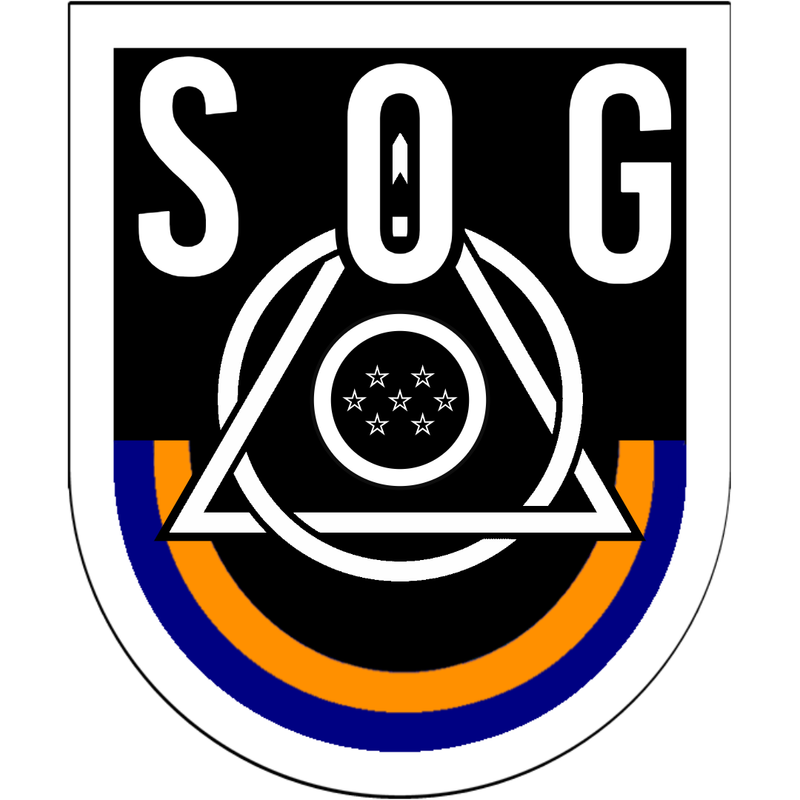
The Special Operations Group (SOG) is the Combined Intelligence Group's Tactical Arm in charge of executing high risk operations that regular agents are not equipped to handle or when military assets are required during an operation. The Special Action Teams (SATs) specifically thrive in close quarters combat, night-time raids, asymmetric warfare, sabotage, hostage rescue, target assassinations, target captures and many more unconventional operations. The most elite tactical unit in SOG is Special Action Team-12 (SAT-12), its priority is operations that include clandestine or covert operations with which the Combine does not want to be overtly associated, recovery of very high value targets, etc.SOG Patch:
Director -
Deputy Director -
Field Flag: