-CSC
Players: Irish_Oligarch
A nation formed under revolution, Ciarrai is a prime example of an underdog story. Ciarrai as a nation did not exist until the late 1800s and was ruled over by the Empire of Reveland, but during a large war in Carinidal, the oppressed Celtic peoples of Ciarrai began to revolt en-masse against Reveland, eventually leading to a large organised revolution across Ciarrai. The largest group of these being the Revolutionary front of Ciarrai. The revolutionary front would go on to form Ciarrai, but what could have been a prosperous Communist nation was quickly turned into a tyrannical dictatorship that would utilise its newly gained power to invade nearby nations and oppress its people. For roughly 3 years (1893-1896), the nation became more and more tyrannical until one event completely changes the balance of power, a well known young advocate for civil rights, Cian MacEoghann of the Greenback Militia storms the parliament in Lothundreg with just 1000 soldiers versus the almost 200,000 revolutionary guardsmen stationed there, he proceeds to hold out for an entire week and on the final day, he and 8 other soldiers held the steps of the parliament with just 5 rifles and 2 canons, Cian MacEoghann would die on those steps, causing the largest influx of civilians joining the greenback militia since its formation. Throughout the next year, the Ciarran civil war would be waged, ending with the final taking of Lothundreg by Greenback Militia forces under General Colm Neely. The war would end in 1897, and Greenback forces would establish a free congressional republic with a relatively unknown town being named the capital. Since then, Ciarrai has become a regional powerhouse and only continues to grow with democracy always on its mind.
GDP: 46,617,170,054 ₽
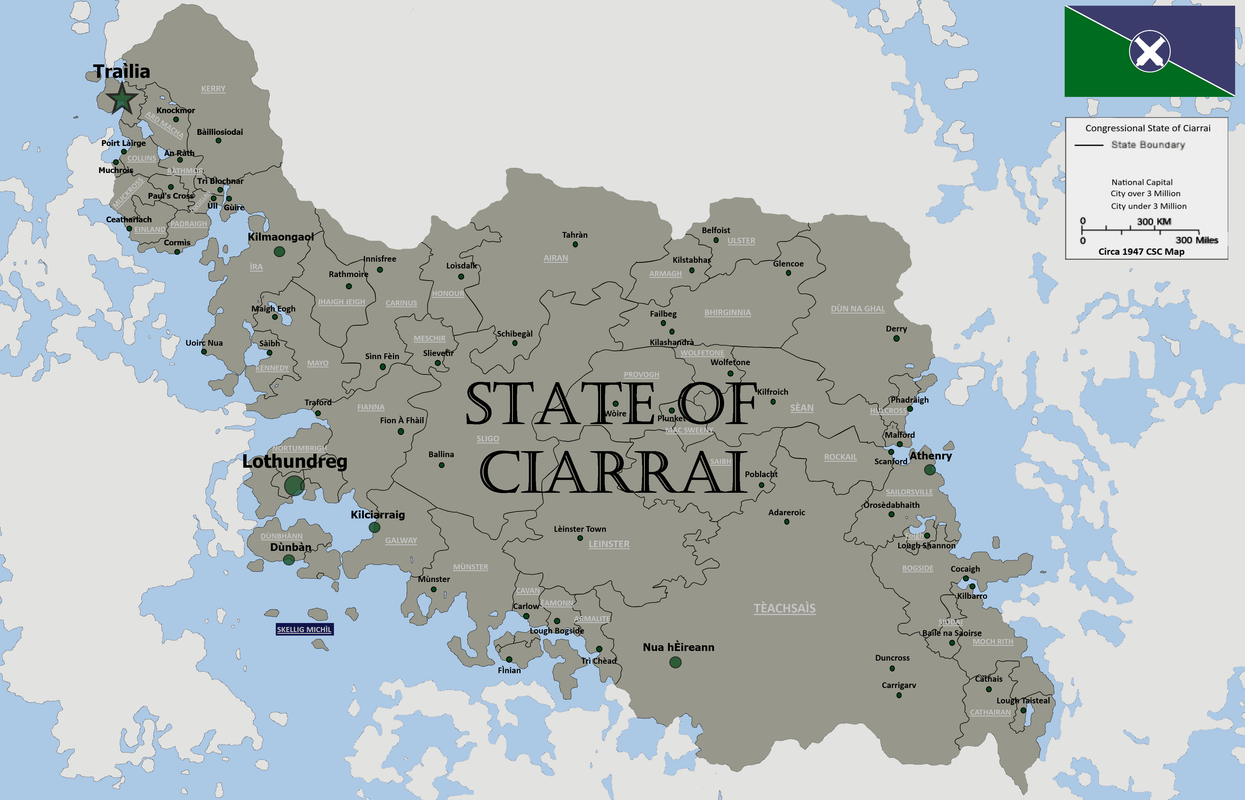
GDP: 46,617,170,054 ₽
National Spirits
| Spirit | Notes |
| Military Political Party (+/-) | Since Ciarrai's civil war, the military has always had a political branch in the congress. The military party is renowned for being very pro military funding and is the main source of military bills in the congress, this leads to a well working armed forces that always has its needs fulfilled but does not get too much due to the opposition in the congress. The downside to this is that usually when the military gains a majority in the congress, they take a stance of aggression and massive military expansion. |
| Bitterness From Great War (+/-) | Ciarrai was on the losing side of the great war, however, Ciarrai was not actually losing, rather they had been slowly beating back its enemies on the naval front which was where all of Ciarrai's battles took place. Due to this, Ciarrai's people refuse to accept this loss it has given them a drive to become better and stronger than before, it also has given Ciarrai's people a resentment towards its former enemies. |
| Low Corporate Tax (+) | Ciarrai is notorious for its very low corporation tax, being just 7%. This has allowed for hundreds of domestic companies to prosper and send more funds into their endeavours instead of the government, it has also caused many foreign companies to move in. Additionally, Ciarrai's corporation laws prevent monopolies by protecting small businesses and closely monitor them at all times which prevents almost all downsides to corporate tax being so low. |
| Home Of The Free (+) | Ciarrai is widely regarded as a very free nation, freedom of thought, religion and freedom of speech are highly encouraged in both its constitution and schools respectively. This has allowed for a prosperous society to develop with Ciarrai being considered a very friendly place to live. |
| Intellectual Nation (+) | Ciarrai also is known for its vast number of colleges, universities, schools and libraries across the nation, with education being free entirely. This has lead to a extremely high literacy rate of 89% and a notable intellectual community of various physicists, mathematicians, engineers, astrologists, architects and so on. |
| Mass Immigration (-) | Due to so many benefits and incentives to live in Ciarrai, Ciarrai has seen a large increase in immigrants from countries across the planet, instead of turning these immigrants away, the Ciarran government in power decided to permit the entry of migrants legally. This has lead to prices rising for housing due to increased population and is leading to more houses having to be built. |
| Rising Nationalism (-) | Another consequence of losing the great war is nationalism growing more and more, with 20% of the population being considered staunch nationalists, this is not inherently bad but has caused more support for the military among citizens which could lead to bad events down the line. |
| Regional Protectors (-) | Ciarrai has put into its decrees that it will protect all Carinidal nations from foreign attacks and protect Carinidal nations from other attacking Carinidal nations if it is an obvious act of aggression. Additionally Ciarrai has stated that it will mediate issues between Carinidal nations and will provide help to those who seek it. At first glance this seems good but it is only good for other nations, for Carinidal it means more resources and capital invested into foreign nations which not many people are fond of supporting. |
National Language
The national language is mainly Irish Gaelic (Gaelige), additionally there are small pockets of Reveish due to Reveland having owned the land for long periods of time. Finally, English is widely known and taught in schools with around 67% of the population being capable of speaking it and 42% being fluent. Capital City
The capital city of Ciarrai is Traília. Situated in the furthest North Western side of the nation and standing as the second most populous city with 6 million current residents, Traília is the current seat of government of Ciarrai and is where the senate building (An Teach Bán), the supreme court building (The Four Courts), the department of defence building (Áras an Fhórsa Cosanta), the main civilian welfare building(An Teach an Rialtais), the “6 Towers of Liberty” and finally the capital building or the congress building (Halla Rialála Coigríche/Congressional Hall of Governance) are all located. Additionally, the city is very culturally significant and contributes greatly to the Ciarran economy by acting as Ciarrai’s northernmost port, Ciarrai’s largest port (and by extent the world's largest port) and it being the hometown of the one man responsible for Ciarrai’s republic, Cian MacEoghann. There exists a national park to honour Cian with a large white spire akin to the Washington monument marking the burial point. Additionally, mountains dot the outside of the city and some directly overlook the city as a whole, making for a very well protected city from storms and heavy winds.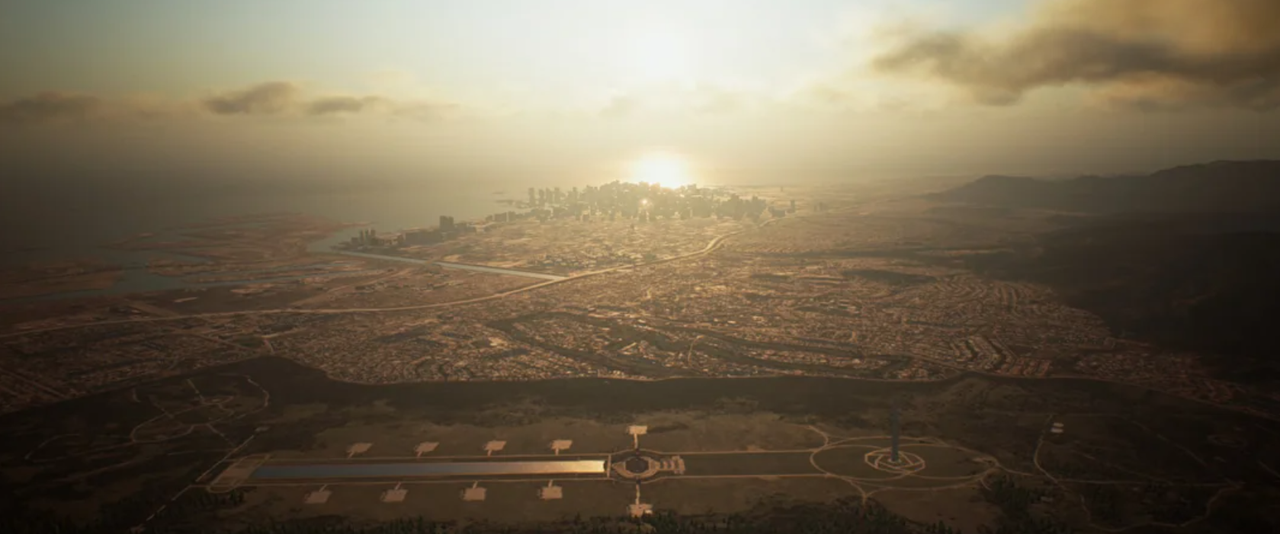
(it would look very similar to Farbanti from ace combat)
78,630,914 is the number of registered citizens of Ciarrai, 80% of which are Ciarran Celtic by ethnicity, 4% being Revish, 10% being a mix between Revish and Celtic and the remaining 6% being various different ethnicities. The reasoning behind this demographic is that Reveland attempted many times to integrate the Celtic tribes of Ciarrai, but failed on most of their attempts, only succeeding when not forcing integration and just allowing Revish people to move into Celtic lands.
Additionally, the population of Ciarrai has a varied population by age, with 27% being the ages between 20 and 40 years old, 33% being ages between 0 and 19, then 36% being ages 41 to 60 and lastly the remaining 4% being ages 61 to 80. This is mainly due to a very recent explosion in Ciarrai’s population and not inherently due to lack of elderly care.
Ciarrai's population has been stagnating in growth due to the rollback of social expenditures by the government in favour of more economic expenditure and giving Ciarran citizens economic stability.
Just under the congress in terms of power is the senate which controls which bills and legislations make it to the congress floor for deliberation, the senate is elected by civilians in regional elections alongside mainline elections, members of the senate are all independent and do not fall under any parties to avoid bias, and each member is screened before being allowed to enter the elections to the senate.
Adjacent to the senate is the council of the congress, which are the main order keepers of the congress such as the speaker and the people in charge of taking votes from the representatives and moderators of cliques etc. Each council member is taken from each party in equal amounts each congress session.
The judicial branch is headed up by the supreme court of the Congressional Republic (SCCR), which elects a set number of 14 supreme justices to make decisions on law relating to the entire country, the SCCR can overrule rulings in court, make rulings etc. Before a case is brought before the Supreme Court of the Congressional Republic, they must be brought before the provincial Supreme Courts which decide on rulings relating to provincial law, then under those lie county courts, then city courts and finally town courts. County courts, city courts and town courts act as regular courts with specific judges that preside over cases instead of 14 like the supreme courts.
Economy
Ciarrai's economic system is characterized by a mixed economy that combines elements of capitalism and government intervention. While the country predominantly operates within a framework of capitalism, where private entities own and control the means of production and market forces determine the allocation of resources, the government intervenes in various aspects of the economy to ensure fairness, stability, and social welfare. This intervention takes the form of regulations, taxation, and social welfare programs.
In terms of limitations and freedoms, Ciarrai's government enforces several measures internally to regulate economic activities and maintain a balance between economic efficiency and social welfare. One significant aspect is the limitation on monopolies. Laws are in place to prevent the formation of monopolies or oligopolies that could stifle competition and harm consumers. Antitrust regulations are rigorously enforced to promote a level playing field in the market and ensure fair competition.
Furthermore, the regulation of insider trading is another crucial aspect of Ciarrai's economic landscape. Insider trading is strictly regulated to ensure fairness and transparency in financial markets. Laws prohibit individuals from trading securities based on material non-public information, thereby safeguarding the integrity of the financial system and protecting investors' interests.
As of the election of the coalition between the Military Party, the Front of Superiority and the Democratic Party in 1956, the Ciarran economy has experienced massive exponential growth and has retained a steady growth percentage of 6-7% each year and having grown the economy by 137.1% since 1947.
Centralization
Ciarrai is very similar to the United States in its centralisation, that being that each province dictates its own laws to an extent, that extent being essential laws like murder or robbery and other laws being federal laws put in place by the supreme court of the Congressional Republic. Federal agencies like the Federal Office of Investigation, the Office of Drug Enforcement and the Revenue Investigations Bureau are responsible for enforcing federal laws while provincial laws and basic laws are enforced by the An Garda Siochána or the police force. The police force is not broken up into departments for cities and towns but is instead broken up into sections for provinces and smaller forces in said provinces being in charge of specific areas like metropolitan areas and port areas. Police officers or Guards can often be reassigned to different provinces if manpower shortages require it, additionally each station has a barracks and larger ones have dedicated estates for officers residences. The Guards will usually transfer cases to federal agencies if federal laws are broken and the federal agencies can veto and change decisions on arrests if they relate to a federal crime, if malpractice is found being undertaken by either the An Garda Siochána or a federal agency, measures are in place to allow the provinces supreme court to force a resolution, if the guards attempt to hinder an investigation into a federal crime or meddle with federal agencies, the supreme court of the province can forcefully transfer the case to federal agents and vice versa.
The reasoning for provincial autonomy is due to the size of the nation and the differing customs for each province, for example the province of Téachsáis is much more forgiving to criminals due to its history of being for the people while the province of Kerry is extremely harsh to criminals due its culture of criminals being the worst scum on the planet. All laws are screened by a Federal Administration based out of Traília that must be sent a reasoning for the law change, voting results on the law change by the people and provincial house of representatives, the predicted results of the law change and the desired results of the law change. The Federal Administration in charge of this is known for being highly professional and will reject any and all “joke laws” but usually accepts all law changes if presented correctly and if the votes are supportive of it. This is to avoid a province's government instating laws that could send the province into chaos or an economic downturn, if the province also detects bias in the decision made by the Federal Administration they can attempt to overturn a decision in the Supreme Court of The Congressional Republic
The governance structure of Ciarrai is a complex interplay of political parties, ideologies, and cultural factors. While there are distinct divisions and varying priorities among different parties, a certain level of cohesion exists to facilitate effective decision-making and governance.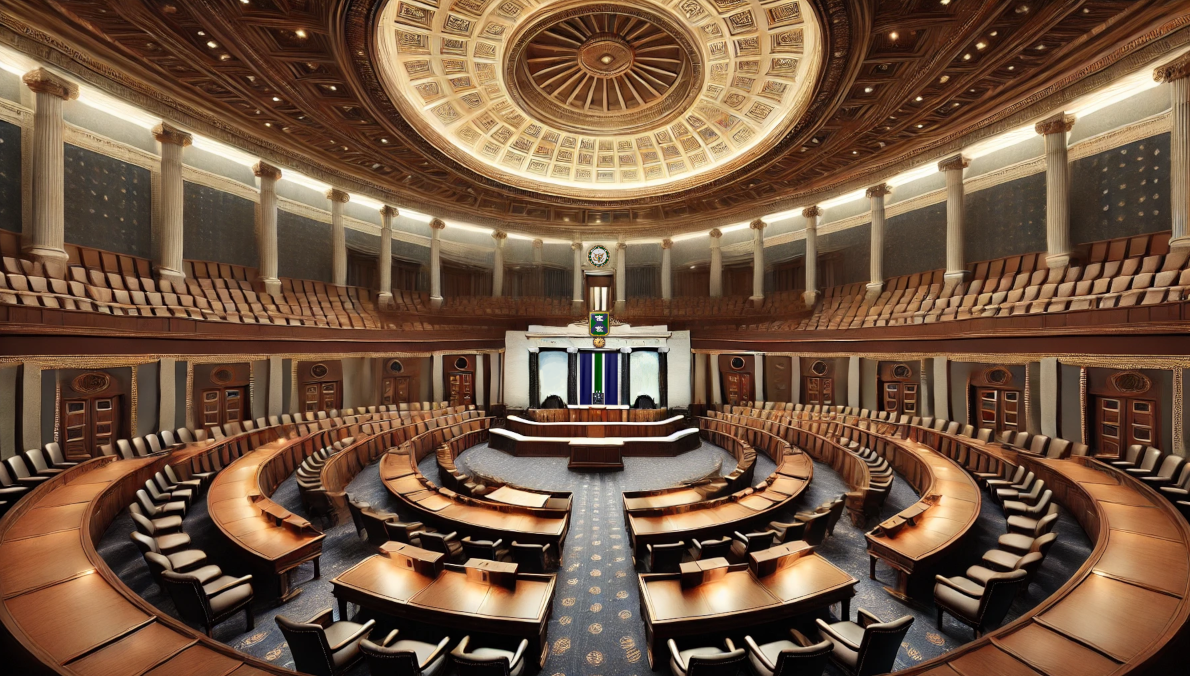
(Picture of the Congressional Hall of Governance in Traília)
Political Parties and Their Agendas:
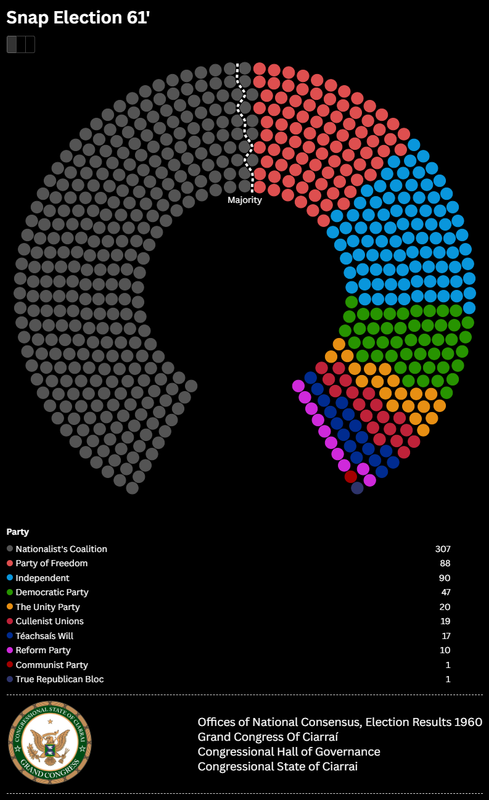
Military Party (126 seats): In Ciarrai, the Military Party represents a nationalist perspective, emphasizing strong defence and national security. While they lean towards the right on military-related matters, they adopt a more centralist approach in broader governance issues. Their primary focus is on defence strategy, modernization, and international partnerships. Front of Superiority (126 seats): Emerging suddenly in 1956, the Front of Superiority is a more radicalised version of the military party that emphasises extreme expansion through various means to increase Ciarrai's control over it's region, constantly vowing to return Ciarrai to its former glory. The party's domestic policies however vary wildly but is usually lean right on the political spectrum, with hints of nationalism. Party of Freedom (70 seats): The Party of Freedom champions socialist and liberal ideals, advocating for social equality, individual rights, and public welfare. Their agenda aligns with policies related to education, healthcare, and income distribution. While they may find common ground with the Military Party on social issues, differences often arise concerning economic policies. Democratic Party (83 seats): Holding conservative and libertarian views, the Democratic Party prioritizes limited government intervention, personal freedoms, and free-market principles. They aim to reduce bureaucracy, encourage entrepreneurship, and safeguard civil liberties. Their debates frequently revolve around economic policies, taxation, and regulations. Independent Members (120 seats): Independent members in Ciarrai's government contribute to the diversity of perspectives. Their stances may vary, aligning with major parties on certain issues or representing niche concerns. Some independents might share similarities with the ideologies of the larger parties, while others may prioritize local interests. . Communist Party of Ciarrai (20 seats): The Communist Party of Ciarrai advocates for strict communist principles, prioritizing economic and social issues while placing less emphasis on foreign diplomacy or military policy. They focus on wealth redistribution, workers' rights, and state ownership of key industries. Their platform seeks to address social inequality and promote a classless society. Greenback Party (40 seats): The Greenback Party is the political arm of the resurgent provisional greenback militia, a paramilitary group that existed back during the initial formation of the nation and eventually became the force to eject the communists from power and creating a congressional republic in the civil war, the original militia deformed after the war but a group of smaller militias reformed it in 1954 as the Provisional Greenback Militia when the communist party claimed 2 seats in congress. it consistently peddles anti communist sentiment and vows to oppose every policy or political action that the communist party pursues. The party is disinterested in proposing policies of its own as it states its main goal is to preserve the main 4 parties created by the founding fathers, unmolested by communism and therefore leaves the running of the country to them. Reform Party (10 seats): The Reform Party of Ciarrai advocates for pragmatic, centrist policies focused on government transparency, fiscal responsibility, and reducing bureaucratic waste. Prioritizing economic stability and moderate tax reforms, the party aims to support small businesses and the middle class while ensuring affordable healthcare and education within a balanced budget. Acting as a moderating force, it promotes bipartisan solutions and a government that is socially conscious yet grounded in free-market principles, appealing to voters seeking effective governance over ideology.
--------------------------------------------------------------------------------------------------------------- 
Congressional Air Forces - Airforce
The Congressional Air Forces is the second youngest branch, just being formed in 1924, it is the main air section of the Ciarran military. It has an active duty manpower pool of 264,726 and a reserve of 101,218 pilots and ground crew. The Air Forces focuses on a doctrine of defence against enemy air and strategic air superiority. Before 1962, the Air Forces would rarely ever go on the offensive on its own, always being accompanied by the army or navy, but since its promotion into its own branch in 1961, its began focusing more on independent operations to destroy enemy air capabilities. The Air Forces were historically neglected after the great war but recent military initiatives have risen the branch to becoming much more capable and modern. The Air Forces contain a total of over 2100 aircraft of various types, each aircraft has a crew of 5 pilots that can switch in and out to counteract fatigue and each aircraft has 4 dedicated ground crews of 11 men for 24/7 maintenance and rearming capabilities, this can vary depending on aircraft type. The Air Corps is commanded by the Joint Chiefs of Staff, with its own commands for more coordination, these commands are the Air Combat, Strategic and Aerospace Defense and Mobility commands, with bombers being assigned to the strategic command, fighters being assigned to air combat and interceptors being assigned to the aerospace defence command. From there, there are what's called Flights, which contain around 10 squadrons per flight. Most Flights squadrons are attached to army divisions with only 2 flights being given autonomy as dedicated anti air.
Congressional Maritime Marine Corps - Marines
The Congressional Marine Corps is the youngest branch having been formalised by General John Lois Velouvre during the great war in 1940. The Congressional Marine Corps acts as the expeditionary forces of the Congressional State and is known for being the most disciplined and toughened branch. It has an active duty manpower pool of 45,503 and a reserve of 30,503 marines. The Marines main goals include acting as expeditionary forces to foreign nations, like when the 1st Marine Division took part in the defence of Kassia during the Great War and most importantly being the main ground forces in naval invasions.
Military Struggles
Although Ciarrai’s army and navy are top of the line, one branch has brought down the standard for the Congressional armed forces, that being the congressional ground air corps. The congressional ground air corps is an extremely neglected branch that receives nowhere near enough money to satisfy its needs, it also lacks experienced pilots due to all of the pilots transferring to naval aviation during the great war. Another concern/struggle of the military is an issue of lack of sufficient border guards on the nation's land borders, with the minister of defence having to often call in the interior guard/national guard to plug any gaps in the border, even then Ciarrai still struggles to stop a vast majority of illegal immigrants crossing the border. During the great war, Ciarrai had a navy that was unrivalled by even the strongest powers in the world, with only the three hyperpowers of the triumvirate powers actually being capable of going toe to toe with it, but once the war ended Ciarrai was forced to massively demobilize its navy to a quarter of its original size, this has caused a lack in essential ships and has forced Ciarrai to replenish its navy rapidly which it has done very fast but will not recover to pre war standards for several years.
Ciarrai has since began to tackle these weaknesses in its military structure and has effectively recuperated its carrier fleets but now faces the issues of its navy becoming top heavy, and its escort destroyer fleet being seriously outdated. The Air Corps has began receiving more funding and is no longer as behind as before, with the acquirement of Aero Wolf industries, the Congressional Air Corps is being rapidly reinforced by modern aircraft but remains behind on effective staff.
Welfare and Social Support
Ciarrai has very little welfare for elderly, the homeless population, the unemployed and other economically vulnerable people, this is due to the unemployed population being almost non existent due to there being an abundance of jobs and in turn very little homeless people, the main reasoning for the lack of elderly welfare is that Ciarrai not only has a very very low elderly population but most elderly are wealthy and do not require care facilities, the ones that do usually end up with family members and those that don't have families end up with foster families. Ciarrai’s healthcare system is funded entirely by the government and does not charge citizens for treatments and procedures. Finally, the education system is highly effective and subsidized almost entirely by the government, but there being policies in effect to curb overspending for the department of education. Finally, in terms of recreational amenities, most if not all recreational locations are privately owned by businesses or companies and are not subsidized by the government unless required.
Culture and History
Modern Culture and Society
Current fashion trends include suits being very prominent among working people, while some of the less economically fortunate people are known for wearing leather jackets and slicking their hair back, these people are known generally as greasers due to them using grease of their hair to slick them back. One major rising trend is the rising support for the military as it attempts to recover from the forced decommissioning of the navy post great war.
Rituals, ceremonies, and practices central to Caitliceach religious observance include Mass, the sacraments (such as baptism, confirmation, and the Eucharist), prayers (such as the Our Father and the Hail Moira), and participation in religious festivals and events. Mass is typically celebrated weekly, with special services held on holy days such as Christmas and Easter.
Religious holidays and festivals hold significant importance for the population, providing occasions for prayer, reflection, and celebration. Christmas, commemorating the birth of Íosa Críost, is widely celebrated with family gatherings, feasting, and attending Midnight Mass. Easter, marking the resurrection of Íosa Críost, is another major religious holiday, observed with church services, fasting, and festive meals. Additionally, Ciarrai observes various feast days dedicated to saints, such as St. Seamus Day, honouring the patron saint of Ciarrai, which is celebrated with parades, festivities, and religious ceremonies. The prevalence of Caitliceach in Ciarrai is widespread, with the majority of the population adhering to the faith. The Caitliceach Church's influence extends beyond religious matters to encompass education, healthcare, and social services, contributing to its significance in shaping the fabric of society.
Civil Struggles
Current civil struggles include rising nationalism due to the populace believing they won the great war and that the government shouldn't have surrendered, ethnic tensions have also resurfaced in certain regions of Ciarrai, exacerbated by nationalist rhetoric and historical grievances. The perception of unequal treatment or marginalization of certain ethnic or cultural groups has further fuelled social unrest and division within the country. These tensions threaten to undermine the nation's unity and stability, posing significant challenges to governance and social cohesion. The consequences of these civil struggles and social issues are multifaceted and far-reaching. Internally, they threaten to destabilize the political landscape, undermine trust in government institutions, and exacerbate social inequality and division. Moreover, the resurgence of nationalism and ethnic tensions could potentially lead to violent conflicts or civil unrest if left unchecked, posing a grave threat to the nation's overall well-being and prosperity. Externally, these issues have implications for Ciarrai's interactions with other nations or regions. The perception of internal instability and political unrest may weaken the nation's diplomatic standing and credibility on the international stage, affecting its ability to negotiate and engage effectively with other countries. Furthermore, ethnic tensions and nationalist sentiment could strain relations with neighbouring states or ethnic minority communities, potentially leading to regional instability or conflict.
Foreign Relations
Ciarrai has always pursued neutral foreign relations with every nation since its creation. Ciarrai will usually take up peacekeeping missions overseas and often mediates for nations in conflict, Ciarrai has also been responsible for outlining many human rights violations in foreign nations. Ciarrai has expressed interest in joining the Solair pact but debates in congress have led to Ciarrai eventually sticking to an absolute neutrality. Ciarrai’s one point of bias is nations in Carinidal, which after the Greenwood Decree, Ciarrai has vowed to protect from foreign powers and from other aggressive nations in Carinidal, essentially placing itself between any attempts at invasion of Carinidal nations. Ciarrai is also utilizing its superior navy to assist Carinidal nations with coastal guarding and search and rescue operations (similar to the RNLI in real life). Ciarrai has pursued its stance of neutrality since its creation in 1897 but has only committed to protecting Carinidal nations after the great war ended.
Border Statuses
Ciarrai Currently has almost no active border conflicts at all due to its friendly stance towards its neighbours and its constant status of neutrality has allowed Ciarrai to settle all previous border conflicts with its neighbours. Although Ciarrai has no border conflicts, Ciarrai is experiencing a conflict with immigrants crossing into Ciarrai illegally, this has caused Ciarrai to expand its border forces but every now and again there will be an incident where the over enthusiastic border guards have requested military support in cases of massive waves of immigration. In 1947, the Congressional Ground Forces were deployed to the border to stop the influx of immigrants.
Additional Lore
Flag and Coat of Arms
Population
Additionally, the population of Ciarrai has a varied population by age, with 27% being the ages between 20 and 40 years old, 33% being ages between 0 and 19, then 36% being ages 41 to 60 and lastly the remaining 4% being ages 61 to 80. This is mainly due to a very recent explosion in Ciarrai’s population and not inherently due to lack of elderly care.
Ciarrai's population has been stagnating in growth due to the rollback of social expenditures by the government in favour of more economic expenditure and giving Ciarran citizens economic stability.
Government
Ciarrai is a Congressional Republic and a direct democracy, meaning that there is no one head of state like a president or prime minister, with Ciarrai’s main governing body being the congress itself. The congress is made up of first representatives from provinces and counties, there are currently 580 representatives in the Congress. This can understandably cause things to move slowly, which is why if a specific sentiment is held among parties, they can form cliques to speed up voting processes. Cliques can also cross to other parties if representatives agree with other representatives from said party. Additionally, if the party as a whole is attempting to pass a bill, legislation or law, they can hold brief elections in the party to select a leader for the specific bill, leaders change constantly depending on bills and sometimes there are no leaders if one is not elected or if the party itself does not agree with each other.Just under the congress in terms of power is the senate which controls which bills and legislations make it to the congress floor for deliberation, the senate is elected by civilians in regional elections alongside mainline elections, members of the senate are all independent and do not fall under any parties to avoid bias, and each member is screened before being allowed to enter the elections to the senate.
Adjacent to the senate is the council of the congress, which are the main order keepers of the congress such as the speaker and the people in charge of taking votes from the representatives and moderators of cliques etc. Each council member is taken from each party in equal amounts each congress session.
The judicial branch is headed up by the supreme court of the Congressional Republic (SCCR), which elects a set number of 14 supreme justices to make decisions on law relating to the entire country, the SCCR can overrule rulings in court, make rulings etc. Before a case is brought before the Supreme Court of the Congressional Republic, they must be brought before the provincial Supreme Courts which decide on rulings relating to provincial law, then under those lie county courts, then city courts and finally town courts. County courts, city courts and town courts act as regular courts with specific judges that preside over cases instead of 14 like the supreme courts.
Economy
Ciarrai's economic system is characterized by a mixed economy that combines elements of capitalism and government intervention. While the country predominantly operates within a framework of capitalism, where private entities own and control the means of production and market forces determine the allocation of resources, the government intervenes in various aspects of the economy to ensure fairness, stability, and social welfare. This intervention takes the form of regulations, taxation, and social welfare programs.In terms of limitations and freedoms, Ciarrai's government enforces several measures internally to regulate economic activities and maintain a balance between economic efficiency and social welfare. One significant aspect is the limitation on monopolies. Laws are in place to prevent the formation of monopolies or oligopolies that could stifle competition and harm consumers. Antitrust regulations are rigorously enforced to promote a level playing field in the market and ensure fair competition.
Furthermore, the regulation of insider trading is another crucial aspect of Ciarrai's economic landscape. Insider trading is strictly regulated to ensure fairness and transparency in financial markets. Laws prohibit individuals from trading securities based on material non-public information, thereby safeguarding the integrity of the financial system and protecting investors' interests.
As of the election of the coalition between the Military Party, the Front of Superiority and the Democratic Party in 1956, the Ciarran economy has experienced massive exponential growth and has retained a steady growth percentage of 6-7% each year and having grown the economy by 137.1% since 1947.
Centralization
Ciarrai is very similar to the United States in its centralisation, that being that each province dictates its own laws to an extent, that extent being essential laws like murder or robbery and other laws being federal laws put in place by the supreme court of the Congressional Republic. Federal agencies like the Federal Office of Investigation, the Office of Drug Enforcement and the Revenue Investigations Bureau are responsible for enforcing federal laws while provincial laws and basic laws are enforced by the An Garda Siochána or the police force. The police force is not broken up into departments for cities and towns but is instead broken up into sections for provinces and smaller forces in said provinces being in charge of specific areas like metropolitan areas and port areas. Police officers or Guards can often be reassigned to different provinces if manpower shortages require it, additionally each station has a barracks and larger ones have dedicated estates for officers residences. The Guards will usually transfer cases to federal agencies if federal laws are broken and the federal agencies can veto and change decisions on arrests if they relate to a federal crime, if malpractice is found being undertaken by either the An Garda Siochána or a federal agency, measures are in place to allow the provinces supreme court to force a resolution, if the guards attempt to hinder an investigation into a federal crime or meddle with federal agencies, the supreme court of the province can forcefully transfer the case to federal agents and vice versa. The reasoning for provincial autonomy is due to the size of the nation and the differing customs for each province, for example the province of Téachsáis is much more forgiving to criminals due to its history of being for the people while the province of Kerry is extremely harsh to criminals due its culture of criminals being the worst scum on the planet. All laws are screened by a Federal Administration based out of Traília that must be sent a reasoning for the law change, voting results on the law change by the people and provincial house of representatives, the predicted results of the law change and the desired results of the law change. The Federal Administration in charge of this is known for being highly professional and will reject any and all “joke laws” but usually accepts all law changes if presented correctly and if the votes are supportive of it. This is to avoid a province's government instating laws that could send the province into chaos or an economic downturn, if the province also detects bias in the decision made by the Federal Administration they can attempt to overturn a decision in the Supreme Court of The Congressional Republic
Government Cohesion
(Picture of the Congressional Hall of Governance in Traília)
Military Party (126 seats): In Ciarrai, the Military Party represents a nationalist perspective, emphasizing strong defence and national security. While they lean towards the right on military-related matters, they adopt a more centralist approach in broader governance issues. Their primary focus is on defence strategy, modernization, and international partnerships. Front of Superiority (126 seats): Emerging suddenly in 1956, the Front of Superiority is a more radicalised version of the military party that emphasises extreme expansion through various means to increase Ciarrai's control over it's region, constantly vowing to return Ciarrai to its former glory. The party's domestic policies however vary wildly but is usually lean right on the political spectrum, with hints of nationalism. Party of Freedom (70 seats): The Party of Freedom champions socialist and liberal ideals, advocating for social equality, individual rights, and public welfare. Their agenda aligns with policies related to education, healthcare, and income distribution. While they may find common ground with the Military Party on social issues, differences often arise concerning economic policies. Democratic Party (83 seats): Holding conservative and libertarian views, the Democratic Party prioritizes limited government intervention, personal freedoms, and free-market principles. They aim to reduce bureaucracy, encourage entrepreneurship, and safeguard civil liberties. Their debates frequently revolve around economic policies, taxation, and regulations. Independent Members (120 seats): Independent members in Ciarrai's government contribute to the diversity of perspectives. Their stances may vary, aligning with major parties on certain issues or representing niche concerns. Some independents might share similarities with the ideologies of the larger parties, while others may prioritize local interests. . Communist Party of Ciarrai (20 seats): The Communist Party of Ciarrai advocates for strict communist principles, prioritizing economic and social issues while placing less emphasis on foreign diplomacy or military policy. They focus on wealth redistribution, workers' rights, and state ownership of key industries. Their platform seeks to address social inequality and promote a classless society. Greenback Party (40 seats): The Greenback Party is the political arm of the resurgent provisional greenback militia, a paramilitary group that existed back during the initial formation of the nation and eventually became the force to eject the communists from power and creating a congressional republic in the civil war, the original militia deformed after the war but a group of smaller militias reformed it in 1954 as the Provisional Greenback Militia when the communist party claimed 2 seats in congress. it consistently peddles anti communist sentiment and vows to oppose every policy or political action that the communist party pursues. The party is disinterested in proposing policies of its own as it states its main goal is to preserve the main 4 parties created by the founding fathers, unmolested by communism and therefore leaves the running of the country to them. Reform Party (10 seats): The Reform Party of Ciarrai advocates for pragmatic, centrist policies focused on government transparency, fiscal responsibility, and reducing bureaucratic waste. Prioritizing economic stability and moderate tax reforms, the party aims to support small businesses and the middle class while ensuring affordable healthcare and education within a balanced budget. Acting as a moderating force, it promotes bipartisan solutions and a government that is socially conscious yet grounded in free-market principles, appealing to voters seeking effective governance over ideology.
(a mapping of the 1961 snap elections outcome)
Ciarrai's legislative process often involves civil discussions, reflecting a commitment to democratic values and constructive dialogue. While confrontations can arise, especially from independent members who feel strongly about certain issues, the overall tone remains respectful and aimed at finding common ground. Unity within the Ciarrai government is maintained through mechanisms such as coalition-building, cross-party negotiations, and bipartisan committees. These approaches create compromise and bridge ideological differences on important legislative matters. Additionally, engaging with citizens through public consultations and digital platforms ensures that governance remains responsive to the needs and opinions of the population. Ciarrai's historical struggles for independence and a deep-rooted cultural emphasis on cooperation, consensus-building, and community have contributed to political cohesion. The shared history of overcoming challenges such as the Reveia Occupation and a collective commitment to national progress often transcend partisan divisions.
Terrain and Climate
Ciarrai is situated close to the equator, and thus is quite warm and humid, as a result, the nation is very tropical. The nations west and centre was historically covered by vast jungles and forests but due to extreme settlement by the Celtic peoples it has since become more grass and fields than jungles. Ciarrai is mostly flatlands but does have some exceptions like the province of Kerry, which contains the Carrauntoohil mountain range which takes up most of the land in the province and also contains Ciarrai’s largest mountains, the Duwant Peaks (named after a Revish explorer who mapped them out fully), other extremely mountainous regions include Airan province and the Skellig Michíl islands. The vast open fields and forests have allowed Ciarrai to thrive off of its agricultural industry and has allowed Ciarrai more than enough space to expand cities to staggering sizes whilst also being diverse enough to allow the harvesting of more tropical crops and fruits in the hotter provinces.
Major Cities
(In order of size)
1. Lothundreg, 15 million populous. Historical capital of pre-revolution Ciarrai and the Kingdom of Sábhaiste from medieval times, large Shipbuilding City. Contains the historical Capital buildings of all previous empires of Ciarrai such as Sábháiste and the communist government. home to a large financial cluster akin to wall street called “Shamrock Road Exchange”.
Population votes very libertarian.
2. Traìlia, 8 million populous. Current seat of Government.
Population votes equally for each party.
3. Athenry, 5 million populous. Agricultural City, Historical capital of the “3 Headed Empire of Athenry”, considered the nation's symbol of triumph through persistence from it having been burnt down and rebuilt 5 times over 500 years of occupation.
Population votes independent rather than a party.
4. Dùnbàn, 5.3 million populous. Fishing and Port City, rivals of Lothundreg and historically where the celts arrived in Carinidal before expanding out, headquarters of the congressional maritime forces and coast guard.
Population votes moderately for the military party.
5. Nua hÈireann, 4.5 million populous. Largest province capital, very large industrial estate and Ciarrai’s newest city, only being classified as such in 1915. Known for the population being extremely friendly but strong and ready to fight with many families being military families. Hosts the congressional ground forces at MacEoghann military base.
Population votes extremely libertarian.
6. Kilciarraig, 4.6 million populous. The all round city, known for being rebellious, rival city of Lothundreg and historically has a very sporty population, usually wins national football leagues.
Population votes more liberal.
7. Kilmaongaol, 4.4 million populous. All round city, historically where political prisoners were sent before revolution hence the name (gaol meaning jail in Gaelic). Large railway hub and home to many festivals of national pride, a very tech savvy city with some of the most prestigious universities being here.
Population votes equally for each party.
Major Ports/Harbours
In order of size,
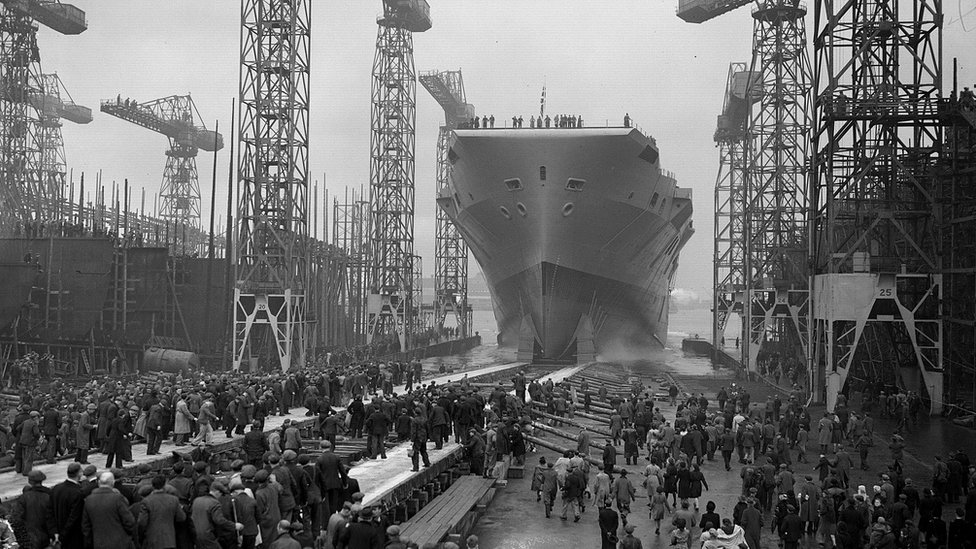
1. Traília contains Ciarrai’s and the world's largest port/dockyard/harbour in the world as of 1947 coming in at 2,450 acres, that being the Coleman and Wolff North Civilian and Military Maritime Facility AKA Fenit Bay Dockyards, situated right on the coast of the city and adjacent to the Highrise section of the city. It has some of the most sophisticated naval production methods and very large shipyards that are capable of creating ships such as Ciarrai’s own supercarriers which it is currently doing. It is capable of docking over a hundred ships at one point, and is also capable of creating entire fleets in just a year due to its large number of shipyards alongside their size. This facility alone brings in massive amounts of income for Ciarrai via trade, it is Ciarrai’s main import and export centre as it is perfectly situated to have direct access to large trading lanes.
Ciarrai's legislative process often involves civil discussions, reflecting a commitment to democratic values and constructive dialogue. While confrontations can arise, especially from independent members who feel strongly about certain issues, the overall tone remains respectful and aimed at finding common ground. Unity within the Ciarrai government is maintained through mechanisms such as coalition-building, cross-party negotiations, and bipartisan committees. These approaches create compromise and bridge ideological differences on important legislative matters. Additionally, engaging with citizens through public consultations and digital platforms ensures that governance remains responsive to the needs and opinions of the population. Ciarrai's historical struggles for independence and a deep-rooted cultural emphasis on cooperation, consensus-building, and community have contributed to political cohesion. The shared history of overcoming challenges such as the Reveia Occupation and a collective commitment to national progress often transcend partisan divisions.
Terrain and Climate
Ciarrai is situated close to the equator, and thus is quite warm and humid, as a result, the nation is very tropical. The nations west and centre was historically covered by vast jungles and forests but due to extreme settlement by the Celtic peoples it has since become more grass and fields than jungles. Ciarrai is mostly flatlands but does have some exceptions like the province of Kerry, which contains the Carrauntoohil mountain range which takes up most of the land in the province and also contains Ciarrai’s largest mountains, the Duwant Peaks (named after a Revish explorer who mapped them out fully), other extremely mountainous regions include Airan province and the Skellig Michíl islands. The vast open fields and forests have allowed Ciarrai to thrive off of its agricultural industry and has allowed Ciarrai more than enough space to expand cities to staggering sizes whilst also being diverse enough to allow the harvesting of more tropical crops and fruits in the hotter provinces. Major Cities
(In order of size)1. Lothundreg, 15 million populous. Historical capital of pre-revolution Ciarrai and the Kingdom of Sábhaiste from medieval times, large Shipbuilding City. Contains the historical Capital buildings of all previous empires of Ciarrai such as Sábháiste and the communist government. home to a large financial cluster akin to wall street called “Shamrock Road Exchange”.
Population votes very libertarian.
2. Traìlia, 8 million populous. Current seat of Government.
Population votes equally for each party.
3. Athenry, 5 million populous. Agricultural City, Historical capital of the “3 Headed Empire of Athenry”, considered the nation's symbol of triumph through persistence from it having been burnt down and rebuilt 5 times over 500 years of occupation.
Population votes independent rather than a party.
4. Dùnbàn, 5.3 million populous. Fishing and Port City, rivals of Lothundreg and historically where the celts arrived in Carinidal before expanding out, headquarters of the congressional maritime forces and coast guard.
Population votes moderately for the military party.
5. Nua hÈireann, 4.5 million populous. Largest province capital, very large industrial estate and Ciarrai’s newest city, only being classified as such in 1915. Known for the population being extremely friendly but strong and ready to fight with many families being military families. Hosts the congressional ground forces at MacEoghann military base.
Population votes extremely libertarian.
6. Kilciarraig, 4.6 million populous. The all round city, known for being rebellious, rival city of Lothundreg and historically has a very sporty population, usually wins national football leagues.
Population votes more liberal.
7. Kilmaongaol, 4.4 million populous. All round city, historically where political prisoners were sent before revolution hence the name (gaol meaning jail in Gaelic). Large railway hub and home to many festivals of national pride, a very tech savvy city with some of the most prestigious universities being here.
Population votes equally for each party.
Major Ports/Harbours
In order of size, 1. Traília contains Ciarrai’s and the world's largest port/dockyard/harbour in the world as of 1947 coming in at 2,450 acres, that being the Coleman and Wolff North Civilian and Military Maritime Facility AKA Fenit Bay Dockyards, situated right on the coast of the city and adjacent to the Highrise section of the city. It has some of the most sophisticated naval production methods and very large shipyards that are capable of creating ships such as Ciarrai’s own supercarriers which it is currently doing. It is capable of docking over a hundred ships at one point, and is also capable of creating entire fleets in just a year due to its large number of shipyards alongside their size. This facility alone brings in massive amounts of income for Ciarrai via trade, it is Ciarrai’s main import and export centre as it is perfectly situated to have direct access to large trading lanes.
2. The second largest port in Ciarrai is the Coleman and Wolff Central Civilian and Military Maritime Facility AKA MacFrancis Bay Port located in Lothundreg. MacFrancis Bay Port has historically been Ciarrai’s main port for 500 years until it was surpassed by Traília, the port is responsible for creating Ciarrai’s only supercarrier in service and is currently producing 1 out of the 3 in production as of 1947. This facility is also extremely large at 1740 acres and is the headquarters for Coleman and Wolff Ship Production Co. It contains more destroyer shipyards and other smaller craft shipyards as opposed to Fenit Bay’s mixture of all types, still, the facility is still capable of producing large ships and is known to be very efficient more so than Fenit Bay since Lothundreg is much less crowded by trade ships. MacFrancis Bay is also strategically unattackable by sea due to there only being 2 ways in and out of the large bay it is situated in.
3. Ciarrai’s third largest port is the port of Dùnbàn which is run by Taispéad Trade Corporation. The port of Dùnbàn is widely regarded as the second most important port to Ciarrai’s economy as it is responsible for being the main southern port for imports and exports to the rest of the world. It is mainly focused on docks and drydocking facilities and does not possess many ship production facilities like Fenit Bay or MacFrancis Bay. The port is also host to the Congressional Coast Guard and The Congressional Maritime Forces or the navy. It has large facilities dedicated to them and is considered as the most strategically important port in Ciarrai. The Dùnbàn port is highly protected by the Ciarran Maritime Forces and is very difficult to attack due to its location. The port is located just outside of the historical city of Dùnbàn where the Celts arrived in Carinidal and the port contains a small museum about it.
All ports are interconnected directly by heavy rail networks that were built specifically for them, additionally, Ciarrai’s extensive motorways allow for heavy vehicles to transport goods in smaller amounts to each port with the government subsidizing important trucking companies each year for transport jobs.
Resources and Economic Produce
Ciarrai is endowed with rich deposits of copper, zinc, and lead, supporting a thriving mining industry. These minerals are extracted from various regions across the country but specifically most minerals come from Dún Na Ghal, Bhirginnia, Séan and Rockall, contributing significantly to economic growth and employment. Moreover, The gemstone mines of Téachsáis produce exquisite emeralds and sapphires, prized for their quality and beauty in international markets.
The fertile lands of Ciarrai yield a plethora of agricultural products, sustaining a flourishing farming sector. Cattle and sheep farming are prevalent, particularly in the lush pastures that characterize much of the country. High-quality beef, lamb, and dairy products are exported from Ciarrai's extensive livestock industry. Additionally, the province of Téachsáis, with its more arid climate, specializes in producing exotic fruits and vegetables, such as bananas, pineapples, and avocados, contributing to the nation's agricultural diversity. The coastal waters surrounding Ciarrai support a thriving fishing industry, harvesting an abundance of seafood that includes cod, salmon, and shellfish with the fishing capital of Ciarrai being Athenry.
In Ciarrai, energy production relies solely on fossil fuels to meet the nation's power needs. The country utilizes coal, oil, and gas to generate electricity and fuel industries. While fossil fuel reserves are limited domestically, Ciarrai strategically imports additional energy resources to supplement its needs. Furthermore, ongoing investments in energy infrastructure aim to enhance energy security and ensure a stable supply of electricity for the nation's development.
In addition to mining, agriculture, and energy production, Ciarrai boasts unique economic assets that drive its economy. The nation's skilled craftsmanship is evident in its artisanal goods, including fine jewellery adorned with locally sourced gemstones but also more military based industries like ship production and weapon production from companies like Coleman and Wolff and Shannon Steel. Ciarrai's landscapes and rich Celtic heritage attract tourists, bolstering the hospitality and tourism industry, particularly in cities like Traília and Dúbán, which feature massive ports facilitating international trade. Furthermore, the nation's emerging technology sector, coupled with a vibrant start-up scene, contributes to its economic diversification and innovation.
Despite its wealth of resources, Ciarrai faces challenges in resource management and trade. Balancing economic development with environmental conservation is imperative to mitigate the impact of resource extraction on ecosystems. Fluctuations in global commodity prices and trade regulations can affect the profitability of resource exports, highlighting the need for diversification and resilience in the economy. Investment in infrastructure, technology, and human capital is crucial to enhance efficiency and competitiveness in resource utilization and trade.
Economic Boons
As stated before, Ciarrai has flourishing shipbuilding, trading, agricultural and resource sectors that make up the vast majority of its economy, with specifically the shipbuilding business causing a massive economic boon post great war due to the government's efforts to rebuild the congressional fleet. Other flourishing sectors include the fishing industry which has always had a large influence on the economy of the land. Ciarrai is additionally exporting a wide arrangement of minerals and more rare crystals for jewellery but also food from farming as mentioned earlier. The main reasoning behind all of these is Ciarrai’s history of prowess in these fields, with agriculture specifically being Ciarrai’s lifeblood for its entire history but also shipbuilding being a relatively recent boon due to a necessity for it, basically Ciarrai being forced to produce a navy to survive and slowly expanding on it.
Economic Struggles
The lack of natural gas and fuel resources severely impacts Ciarrai's ability to meet its energy demands domestically. This reliance on imports not only strains the nation's finances but also makes it vulnerable to fluctuations in global oil prices and geopolitical tensions in oil-producing regions.
The rising prices of fuel and energy could lead to inflationary pressures within Ciarrai's economy, making it more expensive for businesses to operate and for consumers to afford basic necessities. This, in turn, can exacerbate income inequality, as those with lower incomes bear a disproportionate burden of increased living costs. Industries heavily reliant on affordable energy, such as manufacturing and transportation, may struggle to remain competitive or may even face downsizing or closures due to the increased cost of operations. This could result in higher unemployment rates and a decline in overall economic productivity down the line.
The economic challenges faced by Ciarrai could undermine the nation's stability and hinder its prospects for sustained economic growth. Persistent high unemployment and inflation could lead to social unrest and political instability, further deterring investment and economic development.
Economic constraints may also limit Ciarrai's ability to invest in military development and modernization, potentially weakening its defense capabilities and leaving it vulnerable to external threats. Ciarrai's economic struggles may impact its interactions with other nations in various ways. For instance, the need to import oil could influence its foreign policy decisions and diplomatic relations with oil-producing countries. Additionally, economic instability within Ciarrai could affect trade partnerships and regional alliances, potentially straining international relations.
To address these economic struggles, Ciarrai is implementing initiatives such as investing in alternative energy sources, promoting energy efficiency measures, diversifying its economy away from heavy reliance on energy-intensive industries, and fostering international partnerships for energy cooperation and resource sharing. Moreover, policies aimed at reducing income inequality, stimulating job creation, and fostering innovation and entrepreneurship are helping mitigate the adverse effects of the resource deficiency on Ciarrai's economy and society.
Technology Level
Ciarrai is a very tech savvy nation due to many reasons, one main reason being the high literacy rate and the high rate of education amongst the population. This has allowed Ciarrai to start getting the edge in certain fields of expertise, with notable fields where Ciarrai excels in being naval technology and small arms technology, additionally small advancements in aircraft are being made due to the Naval Aviation branch receiving significant funding to expand itself and improve its aircraft, in terms of military technology that Ciarrai is struggling with, Ciarrai lacks expertise in ground based aircraft due to a combination of lack of funding and unsustainable budget which has caused Ciarrai to have to buy bombers from foreign nations or make sub-par bombers for themselves, Ciarrai is also behind in terms of rocket research but has managed to pioneer some anti tank wire guided rockets. Ciarrai also excels in agricultural technology and infrastructure in terms of civilian technology but is notable for falling behind in medical sectors and civilian airliners, which are currently is very widespread usage but with most aircraft companies focusing on naval planes due to the government's recent trials, there has been little to no new domestic airliners forcing airlines to use planes already outdated by several years.
Education and Research
Ciarrai’s education system is renowned for its ability to combine student welfare and forge a strong work ethic within students along with creating many great entrepreneurs in scientific, mathematical, artistic, astrological and many other fields. Ciarrai’s education system falls under the Department of Congressional Academia and is totally funded by the government as education has been deemed a human right by the government, this has allowed even the poorest families to have access to education capable of lifting them out of poverty, however, there are many things that come with Ciarran schools, such as uniform requirements in primary and secondary education sectors and said uniforms being required to be purchased by students or their guardians. Ciarrai’s schools are funded by the government but highly encouraged to keep costs to a minimum whilst also keeping student welfare in mind, this has led to several cases of primary schools being very money hungry and has caused there to be mandatory inspections carried out every second term of the school year. Ciarrai’s school system begins with preschools or kindergartens, where children learn the basics of language, shapes and general things children can spend up to 2 years in these preschools, then comes primary school where students will spend 8 years starting in junior infants and ending with 6th class, students in primary school will continue to learn Gaelige, mathematics, art, geography, religion, science, history and several other subjects. The most notable schools are the religious schools of the Mhuire na Mbraithre where religious monks and nuns teach instead of regular teachers. Then comes Secondary schools, which start with 1st year and end with 6th year, it is notable that 4th year is called transition year as it is a year in between the junior certificate and the leaving certificate where students are encouraged and given the avenues to seek out work experience and are taught to be entrepreneurs in their fields. The leaving certificates are final exams that will determine student academic capabilities and decide what colleges they are eligible to apply to. Students are allowed to select their own subjects in secondary school but are required to have Gaelige, English, math and history with 8 optional subjects, students are required to pick 4 out of the 8 optional subjects. Certain universities require a 3rd language other than Gaelige and English, the most picked language is Revish. Universities are the final level of education, this is where the subjects chosen from secondary school matter the most as to do certain courses, it is required to have done specific subjects. Most courses vary in length but once completed, students will receive diplomas and will be capable of getting higher level jobs.
Military Strength, Composition and Focus
Ciarrai’s military consists of 4 branches, The Congressional Ground Forces, The Congressional Maritime Forces, The Congressional Ground Air Corps, The Congressional Coast Guard and finally The Congressional Maritime Marine Corps.
3. Ciarrai’s third largest port is the port of Dùnbàn which is run by Taispéad Trade Corporation. The port of Dùnbàn is widely regarded as the second most important port to Ciarrai’s economy as it is responsible for being the main southern port for imports and exports to the rest of the world. It is mainly focused on docks and drydocking facilities and does not possess many ship production facilities like Fenit Bay or MacFrancis Bay. The port is also host to the Congressional Coast Guard and The Congressional Maritime Forces or the navy. It has large facilities dedicated to them and is considered as the most strategically important port in Ciarrai. The Dùnbàn port is highly protected by the Ciarran Maritime Forces and is very difficult to attack due to its location. The port is located just outside of the historical city of Dùnbàn where the Celts arrived in Carinidal and the port contains a small museum about it.
All ports are interconnected directly by heavy rail networks that were built specifically for them, additionally, Ciarrai’s extensive motorways allow for heavy vehicles to transport goods in smaller amounts to each port with the government subsidizing important trucking companies each year for transport jobs.
Resources and Economic Produce
Ciarrai is endowed with rich deposits of copper, zinc, and lead, supporting a thriving mining industry. These minerals are extracted from various regions across the country but specifically most minerals come from Dún Na Ghal, Bhirginnia, Séan and Rockall, contributing significantly to economic growth and employment. Moreover, The gemstone mines of Téachsáis produce exquisite emeralds and sapphires, prized for their quality and beauty in international markets.The fertile lands of Ciarrai yield a plethora of agricultural products, sustaining a flourishing farming sector. Cattle and sheep farming are prevalent, particularly in the lush pastures that characterize much of the country. High-quality beef, lamb, and dairy products are exported from Ciarrai's extensive livestock industry. Additionally, the province of Téachsáis, with its more arid climate, specializes in producing exotic fruits and vegetables, such as bananas, pineapples, and avocados, contributing to the nation's agricultural diversity. The coastal waters surrounding Ciarrai support a thriving fishing industry, harvesting an abundance of seafood that includes cod, salmon, and shellfish with the fishing capital of Ciarrai being Athenry.
In Ciarrai, energy production relies solely on fossil fuels to meet the nation's power needs. The country utilizes coal, oil, and gas to generate electricity and fuel industries. While fossil fuel reserves are limited domestically, Ciarrai strategically imports additional energy resources to supplement its needs. Furthermore, ongoing investments in energy infrastructure aim to enhance energy security and ensure a stable supply of electricity for the nation's development.
In addition to mining, agriculture, and energy production, Ciarrai boasts unique economic assets that drive its economy. The nation's skilled craftsmanship is evident in its artisanal goods, including fine jewellery adorned with locally sourced gemstones but also more military based industries like ship production and weapon production from companies like Coleman and Wolff and Shannon Steel. Ciarrai's landscapes and rich Celtic heritage attract tourists, bolstering the hospitality and tourism industry, particularly in cities like Traília and Dúbán, which feature massive ports facilitating international trade. Furthermore, the nation's emerging technology sector, coupled with a vibrant start-up scene, contributes to its economic diversification and innovation.
Despite its wealth of resources, Ciarrai faces challenges in resource management and trade. Balancing economic development with environmental conservation is imperative to mitigate the impact of resource extraction on ecosystems. Fluctuations in global commodity prices and trade regulations can affect the profitability of resource exports, highlighting the need for diversification and resilience in the economy. Investment in infrastructure, technology, and human capital is crucial to enhance efficiency and competitiveness in resource utilization and trade.
Economic Boons
As stated before, Ciarrai has flourishing shipbuilding, trading, agricultural and resource sectors that make up the vast majority of its economy, with specifically the shipbuilding business causing a massive economic boon post great war due to the government's efforts to rebuild the congressional fleet. Other flourishing sectors include the fishing industry which has always had a large influence on the economy of the land. Ciarrai is additionally exporting a wide arrangement of minerals and more rare crystals for jewellery but also food from farming as mentioned earlier. The main reasoning behind all of these is Ciarrai’s history of prowess in these fields, with agriculture specifically being Ciarrai’s lifeblood for its entire history but also shipbuilding being a relatively recent boon due to a necessity for it, basically Ciarrai being forced to produce a navy to survive and slowly expanding on it. Economic Struggles
The lack of natural gas and fuel resources severely impacts Ciarrai's ability to meet its energy demands domestically. This reliance on imports not only strains the nation's finances but also makes it vulnerable to fluctuations in global oil prices and geopolitical tensions in oil-producing regions.The rising prices of fuel and energy could lead to inflationary pressures within Ciarrai's economy, making it more expensive for businesses to operate and for consumers to afford basic necessities. This, in turn, can exacerbate income inequality, as those with lower incomes bear a disproportionate burden of increased living costs. Industries heavily reliant on affordable energy, such as manufacturing and transportation, may struggle to remain competitive or may even face downsizing or closures due to the increased cost of operations. This could result in higher unemployment rates and a decline in overall economic productivity down the line.
The economic challenges faced by Ciarrai could undermine the nation's stability and hinder its prospects for sustained economic growth. Persistent high unemployment and inflation could lead to social unrest and political instability, further deterring investment and economic development.
Economic constraints may also limit Ciarrai's ability to invest in military development and modernization, potentially weakening its defense capabilities and leaving it vulnerable to external threats. Ciarrai's economic struggles may impact its interactions with other nations in various ways. For instance, the need to import oil could influence its foreign policy decisions and diplomatic relations with oil-producing countries. Additionally, economic instability within Ciarrai could affect trade partnerships and regional alliances, potentially straining international relations.
To address these economic struggles, Ciarrai is implementing initiatives such as investing in alternative energy sources, promoting energy efficiency measures, diversifying its economy away from heavy reliance on energy-intensive industries, and fostering international partnerships for energy cooperation and resource sharing. Moreover, policies aimed at reducing income inequality, stimulating job creation, and fostering innovation and entrepreneurship are helping mitigate the adverse effects of the resource deficiency on Ciarrai's economy and society.
Technology Level
Ciarrai is a very tech savvy nation due to many reasons, one main reason being the high literacy rate and the high rate of education amongst the population. This has allowed Ciarrai to start getting the edge in certain fields of expertise, with notable fields where Ciarrai excels in being naval technology and small arms technology, additionally small advancements in aircraft are being made due to the Naval Aviation branch receiving significant funding to expand itself and improve its aircraft, in terms of military technology that Ciarrai is struggling with, Ciarrai lacks expertise in ground based aircraft due to a combination of lack of funding and unsustainable budget which has caused Ciarrai to have to buy bombers from foreign nations or make sub-par bombers for themselves, Ciarrai is also behind in terms of rocket research but has managed to pioneer some anti tank wire guided rockets. Ciarrai also excels in agricultural technology and infrastructure in terms of civilian technology but is notable for falling behind in medical sectors and civilian airliners, which are currently is very widespread usage but with most aircraft companies focusing on naval planes due to the government's recent trials, there has been little to no new domestic airliners forcing airlines to use planes already outdated by several years.Education and Research
Ciarrai’s education system is renowned for its ability to combine student welfare and forge a strong work ethic within students along with creating many great entrepreneurs in scientific, mathematical, artistic, astrological and many other fields. Ciarrai’s education system falls under the Department of Congressional Academia and is totally funded by the government as education has been deemed a human right by the government, this has allowed even the poorest families to have access to education capable of lifting them out of poverty, however, there are many things that come with Ciarran schools, such as uniform requirements in primary and secondary education sectors and said uniforms being required to be purchased by students or their guardians. Ciarrai’s schools are funded by the government but highly encouraged to keep costs to a minimum whilst also keeping student welfare in mind, this has led to several cases of primary schools being very money hungry and has caused there to be mandatory inspections carried out every second term of the school year. Ciarrai’s school system begins with preschools or kindergartens, where children learn the basics of language, shapes and general things children can spend up to 2 years in these preschools, then comes primary school where students will spend 8 years starting in junior infants and ending with 6th class, students in primary school will continue to learn Gaelige, mathematics, art, geography, religion, science, history and several other subjects. The most notable schools are the religious schools of the Mhuire na Mbraithre where religious monks and nuns teach instead of regular teachers. Then comes Secondary schools, which start with 1st year and end with 6th year, it is notable that 4th year is called transition year as it is a year in between the junior certificate and the leaving certificate where students are encouraged and given the avenues to seek out work experience and are taught to be entrepreneurs in their fields. The leaving certificates are final exams that will determine student academic capabilities and decide what colleges they are eligible to apply to. Students are allowed to select their own subjects in secondary school but are required to have Gaelige, English, math and history with 8 optional subjects, students are required to pick 4 out of the 8 optional subjects. Certain universities require a 3rd language other than Gaelige and English, the most picked language is Revish. Universities are the final level of education, this is where the subjects chosen from secondary school matter the most as to do certain courses, it is required to have done specific subjects. Most courses vary in length but once completed, students will receive diplomas and will be capable of getting higher level jobs. Military Strength, Composition and Focus
Ciarrai’s military consists of 4 branches, The Congressional Ground Forces, The Congressional Maritime Forces, The Congressional Ground Air Corps, The Congressional Coast Guard and finally The Congressional Maritime Marine Corps.
Congressional Ground Forces - Army:
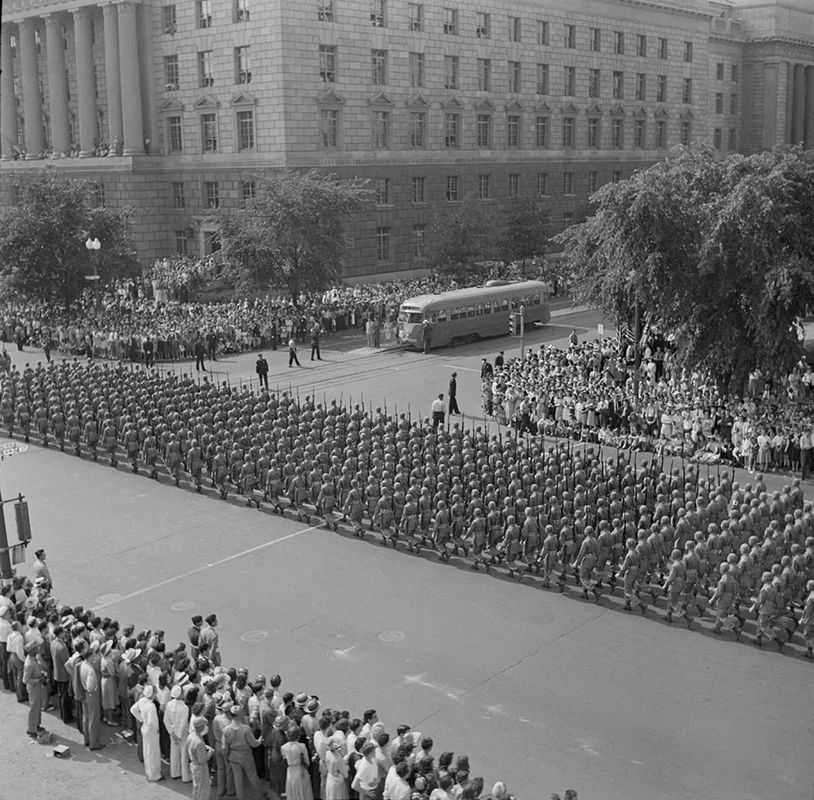
The Congressional Ground Forces, formed in 1897 is the army section of the Ciarran military. It has an active duty manpower pool of 315,926 and a reserve of 138,218 troops. The ground forces main doctrine is asymmetrical or guerrilla warfare based rather than more conventional doctrines, the ground forces are the mainline force of the Ciarran military and are well funded and well supplied. The Structure of the Congressional Ground Forces contains very complex systems of military units and commands but in elementary terms it contains In total, around 24 divisions with varying numbers troops and purposes. The ground forces participate in peacekeeping missions all over the world but are also sworn to protect democracies in Carinidal as part of the 1950 decree by the government and the policies of the Organised Defence Initiative of Carinidal.
The Congressional Ground Forces, formed in 1897 is the army section of the Ciarran military. It has an active duty manpower pool of 315,926 and a reserve of 138,218 troops. The ground forces main doctrine is asymmetrical or guerrilla warfare based rather than more conventional doctrines, the ground forces are the mainline force of the Ciarran military and are well funded and well supplied. The Structure of the Congressional Ground Forces contains very complex systems of military units and commands but in elementary terms it contains In total, around 24 divisions with varying numbers troops and purposes. The ground forces participate in peacekeeping missions all over the world but are also sworn to protect democracies in Carinidal as part of the 1950 decree by the government and the policies of the Organised Defence Initiative of Carinidal.
Image of the 64th Airborne Division of the Congressional Ground Forces on parade in Lothundreg before being deployed to Selengrad, December 30th 1959
---------------------------------------------------------------------------------------------------------------
Congressional Maritime Forces - Navy
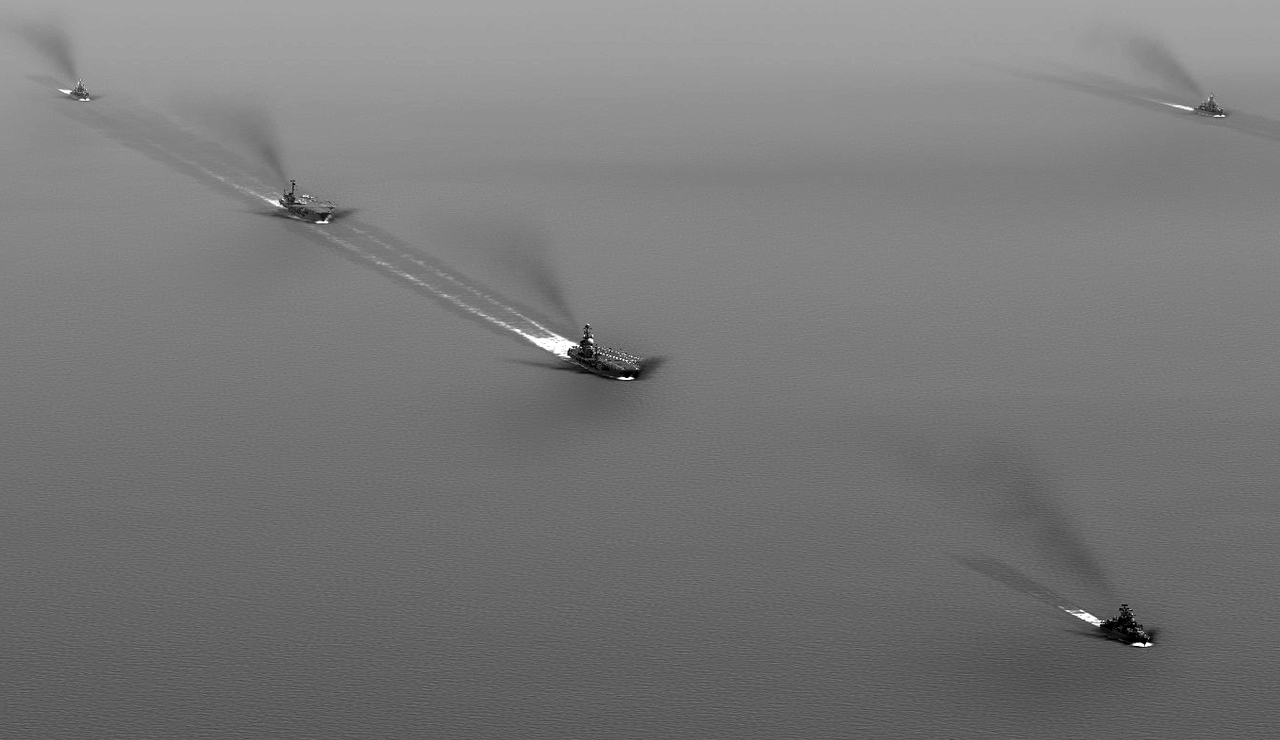
The Congressional Maritime Forces, formed in 1899 alongside the coast guard, the maritime forces are the main naval section of the Ciarran military. It has an active duty manpower pool of 320,926 and a reserve of 157,963 seamen. The maritime forces’ main doctrine is decisive battle and possesses a fleet more than capable of supporting said doctrine, on a more specific level, the doctrine for each fleet is a focus on carriers and aviation forces. The maritime forces are the largest branch of the Ciarran military and receive the most funding out of any branch in the government as a whole. It is the most advanced branch in the military and is focused on heavily by the government in an attempt to replenish it after most of the original fleets were decommissioned post great war. The maritime forces are split into 5 fleet commands, each with a varying number of fleets and ships assigned to them, said commands are the International fleet command, western, eastern and home fleet commands respectively. The largest fleet command is the international fleet command with a number of large fleets under its command and notably is set to contain 2 of the largest carriers in the fleet. The smallest command is the eastern command, which only contains 2 fleets with 6 ships each, the eastern command is the smallest due to the body of water to the east of Ciarrai being a lake but as of the construction of the Amaraeia-Ciarrai canal, production has began on large dockyard facilities in the east coast. Fleet sizes can vary dramatically depending on their tasking and the ships available but the largest fleets contain 50 ships max and the smallest fleets contain 8 ships.
The Congressional Maritime Forces, formed in 1899 alongside the coast guard, the maritime forces are the main naval section of the Ciarran military. It has an active duty manpower pool of 320,926 and a reserve of 157,963 seamen. The maritime forces’ main doctrine is decisive battle and possesses a fleet more than capable of supporting said doctrine, on a more specific level, the doctrine for each fleet is a focus on carriers and aviation forces. The maritime forces are the largest branch of the Ciarran military and receive the most funding out of any branch in the government as a whole. It is the most advanced branch in the military and is focused on heavily by the government in an attempt to replenish it after most of the original fleets were decommissioned post great war. The maritime forces are split into 5 fleet commands, each with a varying number of fleets and ships assigned to them, said commands are the International fleet command, western, eastern and home fleet commands respectively. The largest fleet command is the international fleet command with a number of large fleets under its command and notably is set to contain 2 of the largest carriers in the fleet. The smallest command is the eastern command, which only contains 2 fleets with 6 ships each, the eastern command is the smallest due to the body of water to the east of Ciarrai being a lake but as of the construction of the Amaraeia-Ciarrai canal, production has began on large dockyard facilities in the east coast. Fleet sizes can vary dramatically depending on their tasking and the ships available but the largest fleets contain 50 ships max and the smallest fleets contain 8 ships.
Image of the newly finished Aurelian Sea Class Attack Carriers underway for the first time as part of Naval Exercise Kultur, March 22nd 1960
---------------------------------------------------------------------------------------------------------------
Congressional Air Forces - Airforce
The Congressional Air Forces is the second youngest branch, just being formed in 1924, it is the main air section of the Ciarran military. It has an active duty manpower pool of 264,726 and a reserve of 101,218 pilots and ground crew. The Air Forces focuses on a doctrine of defence against enemy air and strategic air superiority. Before 1962, the Air Forces would rarely ever go on the offensive on its own, always being accompanied by the army or navy, but since its promotion into its own branch in 1961, its began focusing more on independent operations to destroy enemy air capabilities. The Air Forces were historically neglected after the great war but recent military initiatives have risen the branch to becoming much more capable and modern. The Air Forces contain a total of over 2100 aircraft of various types, each aircraft has a crew of 5 pilots that can switch in and out to counteract fatigue and each aircraft has 4 dedicated ground crews of 11 men for 24/7 maintenance and rearming capabilities, this can vary depending on aircraft type. The Air Corps is commanded by the Joint Chiefs of Staff, with its own commands for more coordination, these commands are the Air Combat, Strategic and Aerospace Defense and Mobility commands, with bombers being assigned to the strategic command, fighters being assigned to air combat and interceptors being assigned to the aerospace defence command. From there, there are what's called Flights, which contain around 10 squadrons per flight. Most Flights squadrons are attached to army divisions with only 2 flights being given autonomy as dedicated anti air.
---------------------------------------------------------------------------------------------------------------
Congressional Maritime Marine Corps - Marines
The Congressional Marine Corps is the youngest branch having been formalised by General John Lois Velouvre during the great war in 1940. The Congressional Marine Corps acts as the expeditionary forces of the Congressional State and is known for being the most disciplined and toughened branch. It has an active duty manpower pool of 45,503 and a reserve of 30,503 marines. The Marines main goals include acting as expeditionary forces to foreign nations, like when the 1st Marine Division took part in the defence of Kassia during the Great War and most importantly being the main ground forces in naval invasions.
Image of a group of Marines part of the 1st Marine Division outside of Zinsala central train station.
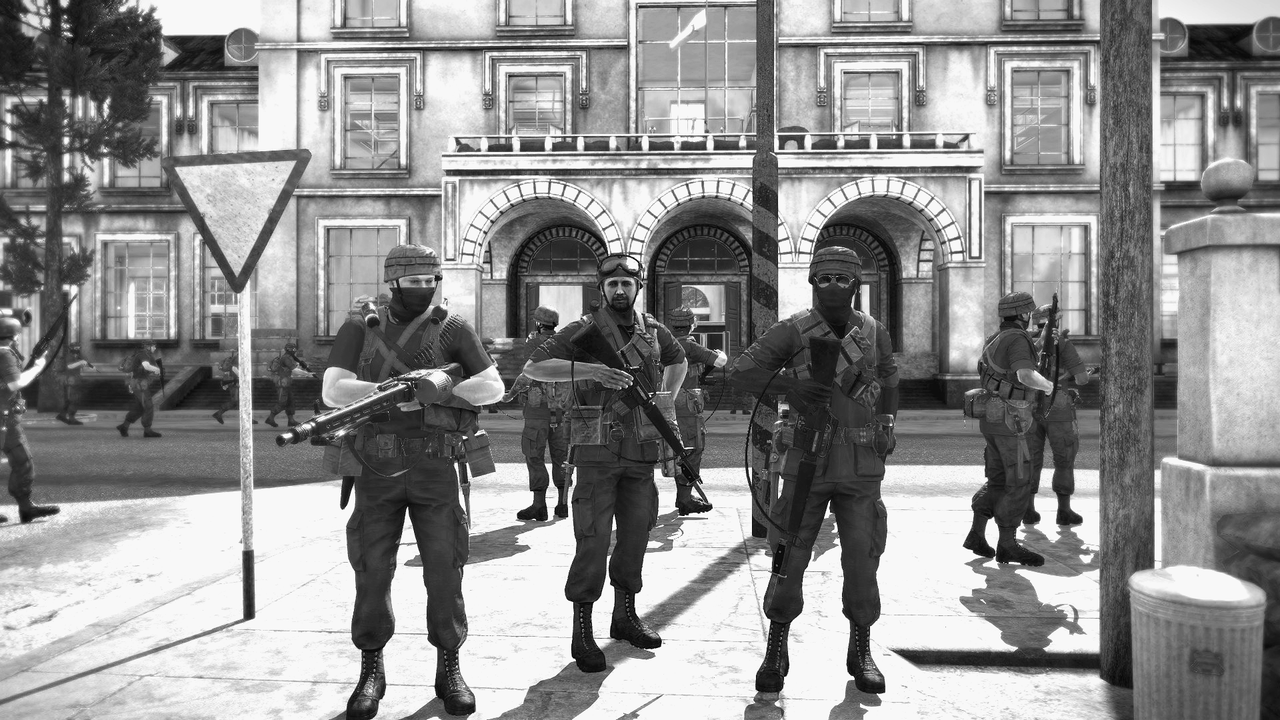
Military Struggles
Although Ciarrai’s army and navy are top of the line, one branch has brought down the standard for the Congressional armed forces, that being the congressional ground air corps. The congressional ground air corps is an extremely neglected branch that receives nowhere near enough money to satisfy its needs, it also lacks experienced pilots due to all of the pilots transferring to naval aviation during the great war. Another concern/struggle of the military is an issue of lack of sufficient border guards on the nation's land borders, with the minister of defence having to often call in the interior guard/national guard to plug any gaps in the border, even then Ciarrai still struggles to stop a vast majority of illegal immigrants crossing the border. During the great war, Ciarrai had a navy that was unrivalled by even the strongest powers in the world, with only the three hyperpowers of the triumvirate powers actually being capable of going toe to toe with it, but once the war ended Ciarrai was forced to massively demobilize its navy to a quarter of its original size, this has caused a lack in essential ships and has forced Ciarrai to replenish its navy rapidly which it has done very fast but will not recover to pre war standards for several years.Ciarrai has since began to tackle these weaknesses in its military structure and has effectively recuperated its carrier fleets but now faces the issues of its navy becoming top heavy, and its escort destroyer fleet being seriously outdated. The Air Corps has began receiving more funding and is no longer as behind as before, with the acquirement of Aero Wolf industries, the Congressional Air Corps is being rapidly reinforced by modern aircraft but remains behind on effective staff.
Welfare and Social Support
Ciarrai has very little welfare for elderly, the homeless population, the unemployed and other economically vulnerable people, this is due to the unemployed population being almost non existent due to there being an abundance of jobs and in turn very little homeless people, the main reasoning for the lack of elderly welfare is that Ciarrai not only has a very very low elderly population but most elderly are wealthy and do not require care facilities, the ones that do usually end up with family members and those that don't have families end up with foster families. Ciarrai’s healthcare system is funded entirely by the government and does not charge citizens for treatments and procedures. Finally, the education system is highly effective and subsidized almost entirely by the government, but there being policies in effect to curb overspending for the department of education. Finally, in terms of recreational amenities, most if not all recreational locations are privately owned by businesses or companies and are not subsidized by the government unless required.Culture and History
Ciarrai as a nation did not exist until 1895 when the revolutionary front of a united Ciarrai took advantage of a brutal war between Reveland and Kutsan to break free from Reveland and establish an all Celtic state under communism. But long long before that, at some point around 200 BC, Celtic tribes arrived in Ciarrai via boats, they landed at the location of the modern day city of Dùnbàn and it is commonly debated where they originated from. The Celtic tribes would expand extremely rapidly and eventually reach the far east to Loch Mór from there, tribes split and fractured but they dominated and eventually overtook all other cultures native or foreign to the land known as Ciarrai. Around 100 years later, an emperor would unite Carinidal under his empire, the emperor's name was Carinus the great. During his rule, Carinus built a large fortress that would contain the pinnacle of architecture, military logistics and large defences that would make it impenetrable. When Carinus inevitably dies, this fortress would be well sought after by all kingdoms and lords in its proximity; the only clan to actually obtain the fortress was the O’Halloran clan. The O’Halloran clan would go on to use the fortress as a claim to the Carinus empire and utilize its superior cavalry to take over the west coast of Ciarrai. They would form the kingdom of Sabháiste, which would stand for just 400 years until it was taken over by Reveland, who would take all of Ciarrai. Several revolutions later, and Reveland still had a strong grip on the Celtic tribes. By the 1880s Ciarrai had been under the control of Reveland for 500 years, but the control over the land would be broken when Kutsan and Reveland would enter a bloody war that would open up for a Celtic revolution, this time to liberate all celts under the banner of communism. In 1892, the communist revolutionary front of a united Ciarrai began a campaign of constant raids on Revish army bases, police stations, government buildings and overall began to cripple the occupational forces. Then, in 1895, a revolution on an enormous scale would overthrow the Revish occupation. In the coming days, the new communist government would institute a tyrannical rule, a far cry from the “every man equal” communist utopia promised, then around a year into the communist rule, the communist government would begin a campaign of rapid expansion, during which they would subjugate almost all nearby nations and even annex some land from them. And then, a year later in 1897, a group on the inside of the country would begin a campaign similar to the communist guerrilla fighting, but this time against the communists. The group responsible was known as the Greenback Militia, they had the guns but lacked manpower and support from civilians, that was until a leader of the militia by the name of Sean MacEoghann would take just 1000 troops which was roughly 10% of the greenback’s entire force, and storm the Lothundreg capitol building where the communist government was based out of. Captain MacEoghann and his soldiers would hold the capital building for an entire week, on the final day, with just 8 soldiers, 6 rifles and 2 cannons left, Captain MacEoghann would hold the steps to the capitol building for 8 hours before being flanked and finally executed where he lied bleeding to death. This display of courage inspired hundreds of thousands to fight against the communist government. The war ended with the sieging out of Lothundreg by greenback militia forces, the communists retreated from the capitol and the uptown into the less dense suburbs, they were finally cleared out in the early hours of the next day. Greenback forces would immediately begin the process of establishing a free nation, a constitution and getting rid of all communist institutions put in place over the 2 years they were in power, but more importantly, pulling out of any and all nearby nations that the communists had occupied. To this day, the communist party still exists in Ciarrai as if the government banned it, it would violate the constitution, however, the communist party of Ciarrai has received a total of just 300 votes since free elections were instituted, making them a joke of a political party.
Modern Culture and Society
Ciarrai national culture is very rich due to the Celtic lineage and rich history, filled with all sorts of events that have shaped the culture today, one of the said events is the bleeding spring where Revish assassins executed hundreds of civilians out the front of the parliament of Téachsáis at the order of their emperor. Events like these have made Ciarran people very resilient to hard times and times of strife but also have made Ciarran citizens kind and have fostered a culture of mutual assistance to those in need around them. Additionally, events such as the loss of the great war have made Ciarran citizens confrontational towards non Ciarran citizens. Due to all of these combinations, Ciarran’s are known for being friendly and generally happy people but are strong and band together to seek revenge if someone has wronged them. As of 1947, one major discussion occurring between Ciarran’s is the discussion of if Ciarrai should use its military more aggressively or if it should stick to a neutrality focus.
Current fashion trends include suits being very prominent among working people, while some of the less economically fortunate people are known for wearing leather jackets and slicking their hair back, these people are known generally as greasers due to them using grease of their hair to slick them back. One major rising trend is the rising support for the military as it attempts to recover from the forced decommissioning of the navy post great war.
Religion
In Ciarrai, Caitliceach is the predominant religion, shaping cultural norms, values, and societal behaviors within the nation. The Caitliceach Church plays a central role in the lives of many citizens, providing spiritual guidance, moral teachings, and a sense of community and belonging.Rituals, ceremonies, and practices central to Caitliceach religious observance include Mass, the sacraments (such as baptism, confirmation, and the Eucharist), prayers (such as the Our Father and the Hail Moira), and participation in religious festivals and events. Mass is typically celebrated weekly, with special services held on holy days such as Christmas and Easter.
Religious holidays and festivals hold significant importance for the population, providing occasions for prayer, reflection, and celebration. Christmas, commemorating the birth of Íosa Críost, is widely celebrated with family gatherings, feasting, and attending Midnight Mass. Easter, marking the resurrection of Íosa Críost, is another major religious holiday, observed with church services, fasting, and festive meals. Additionally, Ciarrai observes various feast days dedicated to saints, such as St. Seamus Day, honouring the patron saint of Ciarrai, which is celebrated with parades, festivities, and religious ceremonies. The prevalence of Caitliceach in Ciarrai is widespread, with the majority of the population adhering to the faith. The Caitliceach Church's influence extends beyond religious matters to encompass education, healthcare, and social services, contributing to its significance in shaping the fabric of society.
Civil Struggles
Current civil struggles include rising nationalism due to the populace believing they won the great war and that the government shouldn't have surrendered, ethnic tensions have also resurfaced in certain regions of Ciarrai, exacerbated by nationalist rhetoric and historical grievances. The perception of unequal treatment or marginalization of certain ethnic or cultural groups has further fuelled social unrest and division within the country. These tensions threaten to undermine the nation's unity and stability, posing significant challenges to governance and social cohesion. The consequences of these civil struggles and social issues are multifaceted and far-reaching. Internally, they threaten to destabilize the political landscape, undermine trust in government institutions, and exacerbate social inequality and division. Moreover, the resurgence of nationalism and ethnic tensions could potentially lead to violent conflicts or civil unrest if left unchecked, posing a grave threat to the nation's overall well-being and prosperity. Externally, these issues have implications for Ciarrai's interactions with other nations or regions. The perception of internal instability and political unrest may weaken the nation's diplomatic standing and credibility on the international stage, affecting its ability to negotiate and engage effectively with other countries. Furthermore, ethnic tensions and nationalist sentiment could strain relations with neighbouring states or ethnic minority communities, potentially leading to regional instability or conflict.Foreign Relations
Ciarrai has always pursued neutral foreign relations with every nation since its creation. Ciarrai will usually take up peacekeeping missions overseas and often mediates for nations in conflict, Ciarrai has also been responsible for outlining many human rights violations in foreign nations. Ciarrai has expressed interest in joining the Solair pact but debates in congress have led to Ciarrai eventually sticking to an absolute neutrality. Ciarrai’s one point of bias is nations in Carinidal, which after the Greenwood Decree, Ciarrai has vowed to protect from foreign powers and from other aggressive nations in Carinidal, essentially placing itself between any attempts at invasion of Carinidal nations. Ciarrai is also utilizing its superior navy to assist Carinidal nations with coastal guarding and search and rescue operations (similar to the RNLI in real life). Ciarrai has pursued its stance of neutrality since its creation in 1897 but has only committed to protecting Carinidal nations after the great war ended.Border Statuses
Ciarrai Currently has almost no active border conflicts at all due to its friendly stance towards its neighbours and its constant status of neutrality has allowed Ciarrai to settle all previous border conflicts with its neighbours. Although Ciarrai has no border conflicts, Ciarrai is experiencing a conflict with immigrants crossing into Ciarrai illegally, this has caused Ciarrai to expand its border forces but every now and again there will be an incident where the over enthusiastic border guards have requested military support in cases of massive waves of immigration. In 1947, the Congressional Ground Forces were deployed to the border to stop the influx of immigrants.Additional Lore
All additional lore is located in the discord channel of the Ciarrai discord, here.